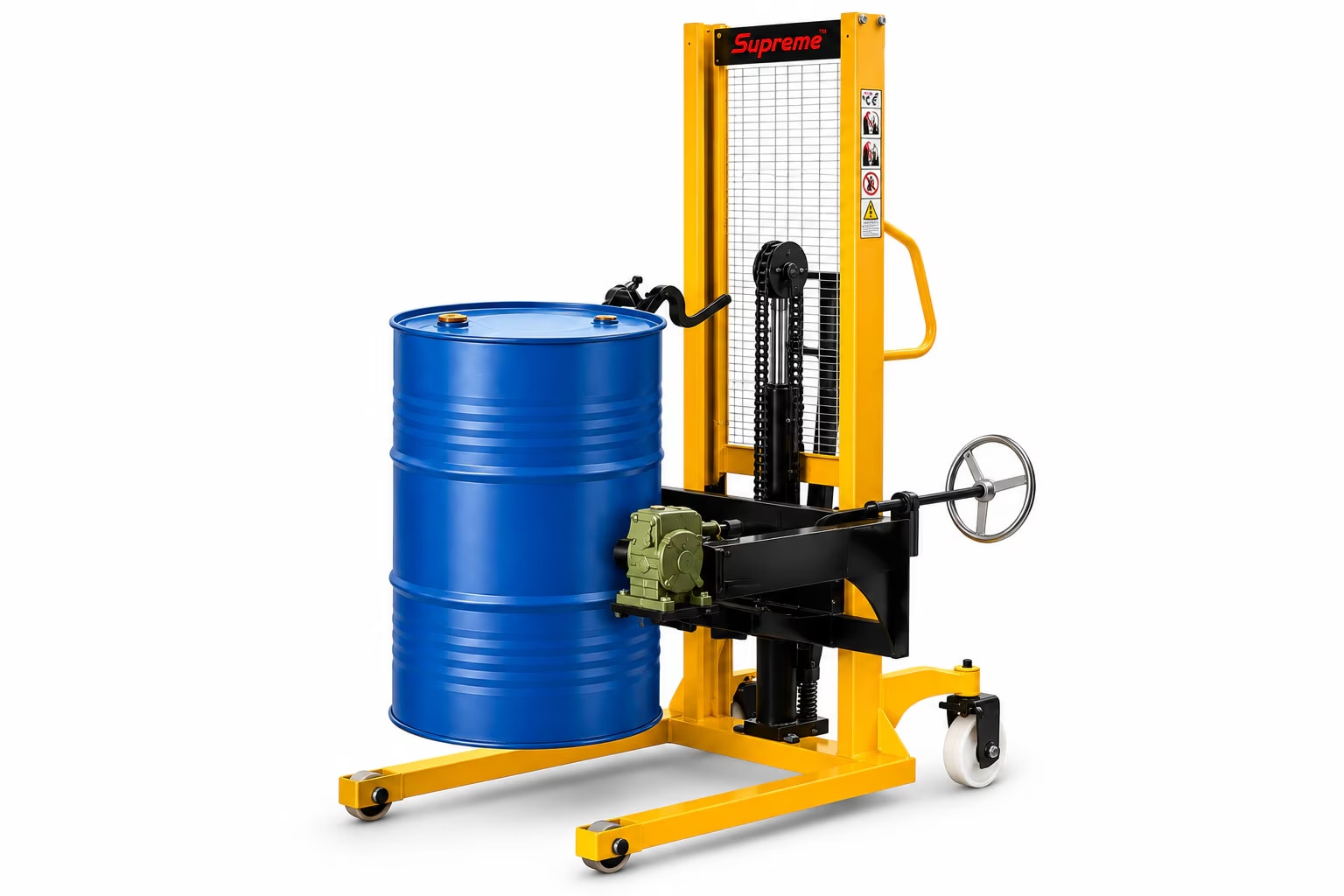
A drum that shifts, rotates or drops during lifting has a retention fault until you prove otherwise. By checking the clamp, drum profile, loading sequence, tilt circuit and safety controls in order, you can separate an operator-loading error from a worn or defective stacker and decide whether the machine must be removed from service.
Key takeaways
- Stop lifting and travel immediately when the drum starts slipping.
- Check jaws, rollers, pins, chains and hydraulic drift before blaming the drum.
- Match clamp size and drum type before loading in the correct sequence.
- Return the machine to work only after a documented acceptance test.
Stop the lift and identify whether the drum or the machine is failing
If a manual drum stacker tilter will not hold drum in jaipur, stop pumping and stop all travel immediately. Do not try to correct the grip while the drum is raised.
Keep people away from beneath and beside the suspended load, then lower it onto a level, stable surface if you can do so without worsening the slip.
- Check whether the gripping lip, jaws, saddle or chime hook has fully engaged the drum rim at both intended contact points.
- Confirm that the drum sits centrally, with the clamp at its stiffest gripping area rather than on a dent, open head or damaged rim.
- Inspect the drum for a different diameter, top-chime profile, thin wall, dents or contamination that could defeat the attachment geometry.
- After the drum is secure, raise it only a few centimetres and stop pumping. Watch for clamp movement, hydraulic drift, wheel lift or frame movement before attempting travel or rotation.
- If the drum stays attached but the stacker tips, lifts a wheel or becomes hard to steer, investigate load height, load centre, uneven ground, wheel condition and rated capacity instead of blaming the clamp.
A search for “drum stacker tilter slipping in jaipur” should not lead straight to a pump replacement. Record the drum type, dimensions, weight, clamp position and the exact movement observed; these details separate incorrect loading from retention failure, hydraulic drift and whole-machine instability.
Inspect every part that creates positive drum retention
Positive retention depends on the clamp jaw, retaining lip or chime hook actually seating under the drum rim; a closed handle alone proves nothing. Stop lifting if either intended contact point is not visibly engaged, or if clearance appears between the retainer and chime.
Inspect the retention path in this order:
- Check the jaw, saddle and retaining lip for bending, cracks, rounded edges, paint buildup or a gap against the chime.
- Check the jaw pivot pin, bushes and linkage for looseness; excess play can let the jaw open under load.
- Check the locking pin or latch for full insertion, deformation and a working keeper. A pin that stops short can look locked but release during travel.
- Check the spring, cable or hydraulic actuator for weak return, leaks and incomplete closure.
- Check frame alignment and fasteners. A shifted bracket can make one jaw engage while the opposite side misses.
| Inspection finding | Likely drum stacker drum holding issue | Immediate check |
|---|---|---|
| Oily, muddy or wet contact surfaces | Friction loss at a friction-dependent clamp | Clean drum and contact faces, then inspect for worn retention |
| Visible chime clearance | Worn or bent lip, jaw, hook, pin or linkage | Remove from service and compare with the supplier’s limits |
| Drum attached but stacker unstable | Load position, height, ground, wheels or capacity | Check stability separately from clamp grip |
A clean surface is diagnostic, not a repair. Do not lift until both contact points hold at low height.
Match the drum to the clamp and load it in the correct order
A drum that fits loosely, sits off-centre, or presents the wrong rim can mimic a mechanical failure. Treat the manual drum tilter problem as a compatibility or loading fault until a known-compatible drum passes a controlled hold test.
- Check the attachment specification against the actual drum: outside diameter, height, top-chime or rim profile, wall condition, gross weight, and centreline. “210-litre drum” is not enough; open-head, dented, thin-wall, plastic, and non-standard drums can defeat a clamp designed for a closed-head steel drum.
- Place the tilter on level ground and align the clamp with the drum’s stiffest gripping area, normally the sound top chime. Keep the drum upright and centred on the attachment’s intended load line.
- Close the jaws, retaining lip, saddle, or chime hook fully in the specified order. Confirm that both intended contact points engage the rim, the locking pin is seated, and no visible gap remains between the retaining component and the chime.
- Raise the rated drum only a short distance, stop pumping, and watch for clamp movement or hydraulic drift. Do not travel or rotate until the drum remains fixed.
- Repeat the check with a verified compatible drum at the permitted load and load centre. If that drum holds while the suspect drum slips, investigate the drum dimensions or loading; if both slip, inspect the clamp and linkage for mechanical defects.
Never test beside or beneath a suspended drum. A bent lip, worn jaw pivot, or loose fastener can still require removal from service even when loading appears correct.
Separate clamp slip, hydraulic drift and whole-machine instability
Raise the drum only a few centimetres on a level surface, stop pumping, and watch what moves. For a drum stacker tilter slipping in Jaipur, the key question is whether the drum moves inside the attachment, the attachment descends, or the entire stacker becomes unstable.
A manual drum tilter problem is not automatically a pump failure.
| Symptom | What to check | Likely fault |
|---|---|---|
| Drum shifts or drops while the stacker stays upright | Jaw, retaining lip, saddle, chime hook and both contact points | Clamp slip caused by incomplete engagement, unsuitable rim profile, damage or loose hardware |
| Attachment lowers with the drum still firmly gripped | Hydraulic ram, hose, control valve and cylinder seals after pumping stops | Hydraulic drift from internal leakage or a failing valve |
| Wheels lift, steering becomes difficult, or the frame leans | Load centre, lift height, ground level, wheel condition and rated capacity | Whole-machine instability, not a retention fault |
Use this acceptance check before travel or rotation:
- Confirm the drum’s diameter, height, rim type, wall condition and weight match the attachment specification.
- Centre the drum at the intended gripping height, close both jaws fully, and verify visible mechanical engagement.
- Raise it a few centimetres, stop pumping, and check for drum movement and ram descent.
- Keep everyone clear; if the drum remains attached but the stacker shifts, lower it and investigate load position, height, ground and wheels before further testing.
Repair, acceptance-test and supplier checks before returning the unit to work
Remove the stacker from service immediately if the drum slips, the jaws fail to close fully, a retaining lip, hook, pivot or locking pin is bent or cracked, the tilt position creeps, or hydraulic oil leaks.
A manual drum stacker tilter will not hold the drum in Jaipur is not safe to keep using because it still raises the load.
1. Record the drum’s material, closed-head or open-head design, diameter, height, rim profile, wall condition and filled weight. Ask the supplier to confirm compatibility in writing; “suitable for 210-litre drums” does not cover every 210-litre drum.
2. Request the attachment’s maximum load, load centre, allowable tilt angle, travel restrictions, required engagement points, inspection points and replacement-part procedure. Ask whether the proposed repair replaces the clamp jaw, retaining lip, spring, actuator, pivot, pin or fasteners, and request the part numbers.
3. After repair, acceptance-test the rated drum on a level surface. Centre it, close both gripping points fully, raise it only a short distance, stop pumping, and check for clamp movement and hydraulic drift. Keep people away from and beneath the suspended drum; test travel and rotation only after the hold remains stable.
A drum stacker drum holding issue that returns after adjustment needs a written failure diagnosis, not a pump replacement by assumption. When reviewing a quote from Supreme Material Handling Equipment, require photographs of the failed parts, the test result, and the load-and-drum specification used for approval.
Related product
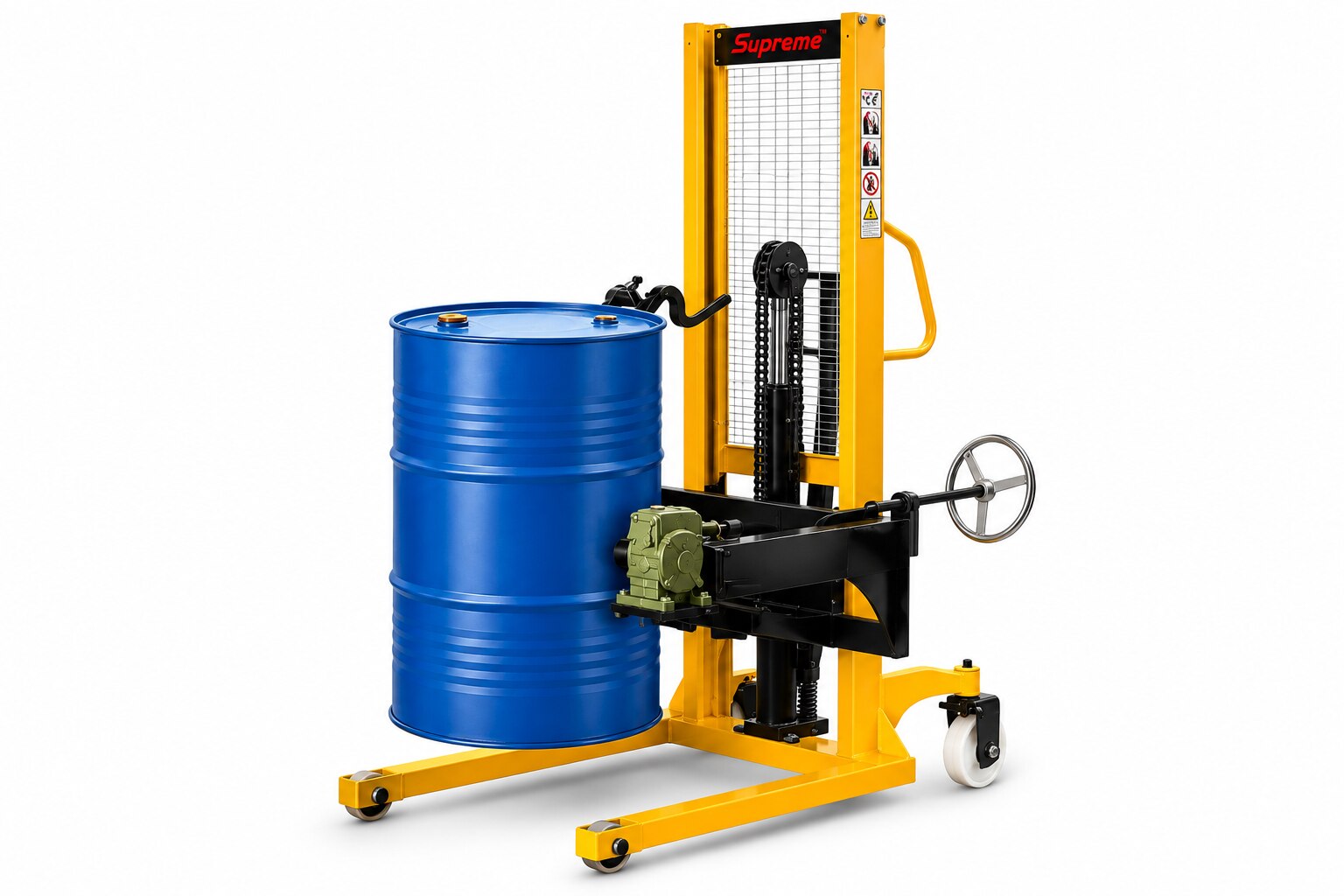 | Manual Drum Stacker Supreme Manual Drum Stacker & Tilter – DS0516-NB Supreme Manual Drum Stacker & Tilter – DS0516-NB The Supreme Manual Drum Stacker & Tilter is a robust and efficient material-handling solution... View product → |
Frequently asked questions
What should you do first when a manual drum stacker tilter will not hold a drum?
Stop pumping and all travel immediately. Keep clear of the suspended load, lower it safely if possible, and identify whether the drum or machine is failing.
Which parts create positive drum retention?
Inspect the clamp jaws, jaw lining, rollers, pins, locking parts, chains, welds and hydraulic components for wear, damage, contamination or looseness.
How do you match a drum to the stacker tilter clamp?
Confirm the drum material, diameter, rim or chime design, weight and surface condition against the clamp’s rated application. Load the drum squarely and follow the specified clamp sequence.
How can you distinguish clamp slip from hydraulic drift?
Clamp slip shows the drum moving within the jaws. Hydraulic drift shows the carriage, mast or attachment lowering without jaw movement. Whole-machine instability includes rocking, tipping, uneven travel or structural movement.
What acceptance checks are needed before returning the unit to work?
Repair the confirmed fault, then test empty and with a representative drum. Check retention, lift holding, tilt control, travel stability, brakes, guards and leaks, and record the inspection.
Keywords