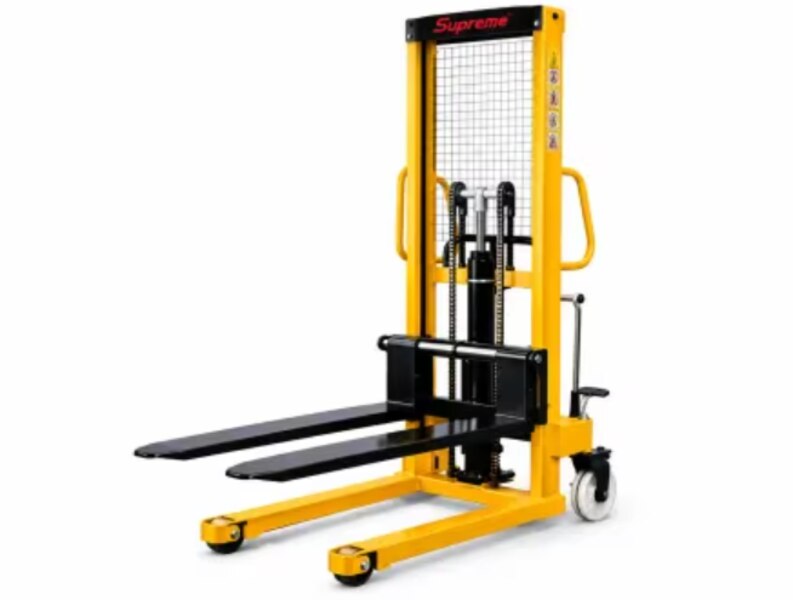
A manual stacker becomes dangerous when the pallet, load centre, route, or hydraulic controls are treated as minor details. Follow a fixed inspection, lifting, travelling, placement, and fault-response sequence so you can handle loads without exceeding the machine’s stability or capacity limits.
Key takeaways
- Inspect forks, wheels, mast, hydraulics, brakes, and labels before every shift.
- Keep the load within the capacity plate and centred across both forks.
- Travel with forks low, a clear view, and controlled pushing or pulling.
- Stop using the stacker when it leaks, binds, rolls, or shows structural damage.
Complete the Pre-Use Inspection Before Every Shift
Check and document the stacker’s condition before every shift and before manual stacker operation begins. Park it on level ground, lower the forks fully, apply the parking brake or wheel locks, and keep hands clear during inspection.
- Read the capacity plate and confirm that it is legible. Note the rated load, permitted load centre, maximum lift height, and any reduced capacity at height.
- Examine both forks for bending, cracks, twisting, excessive wear, or damaged heels. Check that fork tips are level and that the retaining pins are secure.
- Inspect the mast, welds, frame, chains, rollers, and guards. Look for cracked welds, loose fasteners, distorted rails, slack chains, or parts rubbing during movement.
- Check hydraulic hoses, fittings, pump, and cylinders for wetness, oil drops, or fork drift. Test the pump handle and lowering control with empty, lowered forks; lowering must be gradual, not a sudden drop.
- Test the steering handle, wheels, wheel bearings, parking brake or locks, and any control levers. Remove stones, wire, oil, and debris from the wheels.
- Walk the intended route. Clear pallets and waste, confirm lighting, mark pedestrian separation, and arrange a spotter at blind intersections.
If any defect affects manual stacker safety, stop use, isolate the machine, and attach a “Do Not Operate” tag until a competent person repairs and rechecks it. Never inspect beneath raised forks.
Match the Pallet and Load to the Forks and Capacity Plate
Start with the capacity plate, not the pallet weight. Confirm the exact model, rated capacity, permitted load-centre distance, maximum lift height, and any capacity reduction at higher lifts; a load within the stated kilograms can still overturn the stacker when it projects too far forward.
Check the pallet before inserting the forks:
- Use the correct fork-entry direction, with both forks fully inside the openings.
- Confirm each fork fits without forcing against a block, deck board, or side rail.
- Reject pallets with broken boards, loose blocks, protruding nails, oil contamination, or distortion.
- Ensure the pallet provides enough clearance beneath its deck for the fork thickness and heel.
- Centre the pallet on the forks and keep the load’s centre of gravity within the plate’s stated load-centre distance.
- Distribute the weight evenly; secure items that could slide, fall, or shift during lifting.
- Keep the load within the fork length and never allow it to project so far forward that the rear of the pallet loses support.
Do not rely on a generic rating for a manual stacker for factories in Jaipur. Obtain the model’s capacity plate and operating manual, then compare the actual pallet, load centre, lift height, and floor condition with those limits.
During manual stacker operation, keep people away from the forks and never carry a person, stand beneath raised forks, or use the pallet as a work platform.
Lift, Lower, and Travel With Controlled Movements
Release the parking brake or wheel lock before travelling, but keep the stacker stationary while you align the forks. Keep hands and feet clear of the forks and wheels, and never allow anyone to stand beneath raised forks or ride on the machine.
- Approach the pallet squarely with the forks fully lowered. Insert both forks to equal depth, keeping the load centred and the fork tips clear of the opposite pallet board.
- Confirm that people are outside the travel path, then pump the hydraulic handle until the pallet is just clear of the floor. Do not lift higher than needed for movement.
- Lower the forks to the manufacturer’s travel position. Move at walking speed, keep the load low, and stop at blind intersections; use a spotter where the load blocks your view.
- Stop squarely at the storage position. Apply the parking brake or wheel lock before raising the pallet.
- Raise the pallet only enough to clear the rack beam, stack, or floor location. Keep the stacker aligned; a sideways load can strike the rack or shift the pallet.
- Place the pallet gently, lower the forks completely, and confirm that the load is supported before withdrawing. Pull straight back without touching the pallet or rack.
Good manual stacker safety depends on controlled movement, not forceful pumping or speed. Anyone learning how to operate manual stacker in Jaipur should use the model’s travel-position and control instructions, because a hydraulic manual unit does not share every braking or travel assumption of an electric stacker.
Place the Pallet on a Rack or Stack Without Striking It
Stop squarely at the rack or stack location, then apply the parking brake or wheel locks before final placement. Check that the rack beam, shelf, pallet, and floor can support the load, and that the load will not project into an aisle or block sprinklers, lights, doors, or emergency equipment.
- Release the brake only for positioning. Align both forks with the pallet openings and keep the stacker square to the pallet.
- Pump or actuate the lift until the load is just clear of the floor, then lower the forks to the manufacturer’s travel position.
- Move at walking speed, keeping people outside the path. Stop with the forks and pallet centred at the storage position.
- Apply the brake. Raise the forks only enough to clear the rack beam, shelf, or existing pallet.
- Move forward slowly until the pallet is fully supported. Do not push the pallet into place with the stacker.
- Lower the forks completely, confirm the pallet is stable, and withdraw straight back without touching the rack or pallet.
- Stop clear of the storage face, lower the forks to the travel position, and apply the brake.
Keep hands and feet away from forks and wheels, and never stand beneath raised forks. During manual stacker operation, follow the exact capacity plate and manual; a manual stacker for factories in Jaipur is not interchangeable with an electric model’s braking or travel assumptions.
Respond to Faults and Confirm the Exact Model Limits
A drifting fork, leaking hydraulic oil, cracked weld, damaged wheel, failed brake, or control that does not return correctly is a stop-work fault.
Lower the forks to a safe position only if you can do so without creating a hazard, remove the key or secure the handle, keep people clear, label the stacker “Do not use,” and report it to maintenance. Never pump harder to overcome a fault or hold a suspended load on an unverified hydraulic circuit.
Before approving a Supreme manual stacker for a job, record the model and serial number from its identification plate and obtain these exact details:
- Rated capacity at each stated load centre, maximum lift height, and any capacity reduction at elevated heights.
- Fork length, width, thickness, outside spacing, adjustment range, and minimum clearance needed beneath the pallet.
- Minimum turning radius, permitted gradient, approved surface conditions, and the required load orientation on a slope.
- Wheel material, brake arrangement, and the stopping method on the intended floor.
- The operating manual, inspection intervals, hydraulic-fluid specification, and the correct service parts list.
If sourcing or replacing equipment, ask Supreme Material Handling Equipment to match the quotation to this model data rather than accepting “manual stacker” as a complete specification. Manual stacker safety depends on these limits; a load within the mass rating can still make the machine unstable when its centre projects too far forward.
Related product
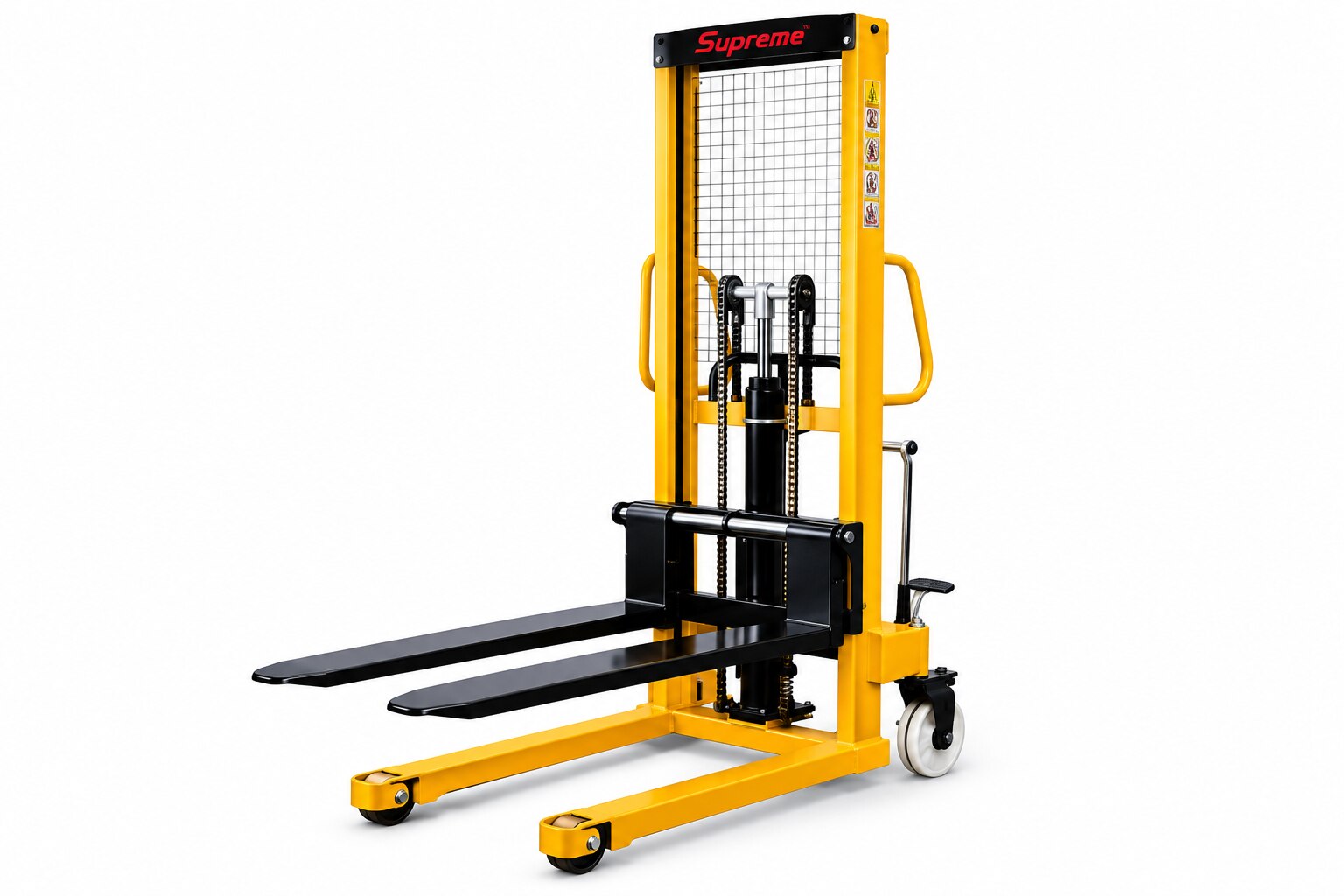 | Manual Stacker Heavy-Duty Hydraulic Pallet Stacker The Supreme Manual Stacker is a reliable and heavy-duty material handling solution designed for efficient... View product → |
Frequently asked questions
What should you check before operating a manual stacker?
Park on level ground, lower the forks, apply the brake or wheel locks, then inspect the forks, wheels, mast, hydraulic system, controls, labels, and frame before each shift.
How do you match a pallet and load to a manual stacker?
Read the capacity plate, confirm the load weight and centre, and use a pallet that fits fully on both forks without broken boards, unstable contents, or excessive overhang.
How should you lift, lower, and travel with a manual stacker?
Use controlled pump and release movements, keep hands clear, lower the forks before travelling, maintain a clear view, and move slowly around people, corners, ramps, and uneven floors.
What should you do when a manual stacker develops a fault?
Stop work, lower the load, isolate and label the stacker, report the fault, and verify the exact model’s rated capacity, operating limits, and repair instructions before reuse.
Keywords