A model name alone cannot tell you whether a semi-electric stacker will lift your pallet safely, fit your aisle, or complete a full shift. By the end, you will know which capacity, mast, fork, battery, travel, charger, safety, and delivery details to demand before accepting a Jaipur quotation.
Key takeaways
- Record the exact model, kilogram capacity and lift configuration.
- Measure pallet openings, door heights and aisle widths before choosing forks.
- Confirm whether lifting, travel and braking use electric power.
- List the battery, charger and every included item on the quotation.
Start with the exact model, rated capacity and lift configuration
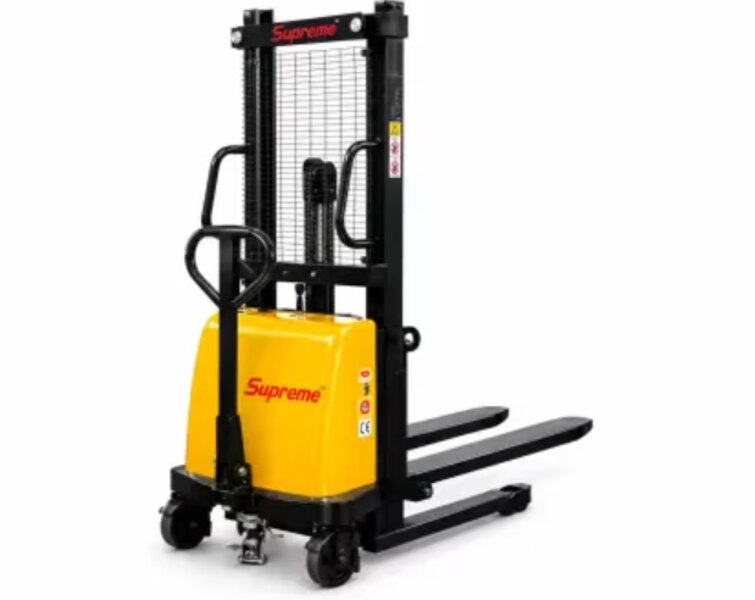
Start by recording the exact model code, rated capacity in kilograms, and lift configuration; “Supreme semi electric stacker” alone does not identify the machine. Ask for these supreme semi electric stacker details in writing:
- Rated capacity at a 600 mm load centre, or the stated load centre
- Full load chart, including residual capacity at raised fork heights
- Maximum lift, lowered fork height, free lift, mast type, and raised mast height
Common market configurations of about 1,000–1,500 kg and 1.6–3.5 m are comparison ranges, not verified specifications for a particular unit.
| Quoted information | What it establishes | What is missing if absent |
|---|---|---|
| Rated capacity only | Headline load at a specified condition | Capacity at your load centre and lift height |
| Maximum lift only | Highest fork elevation without usable-placement detail | Pallet, beam, and clearance calculation |
| Capacity chart with residual figures | Safe capacity as the forks rise | Nothing essential for capacity comparison |
Capacity falls when the load centre grows because the load creates more overturning force ahead of the mast. It also falls as the forks rise, so reject a quotation that lists only maximum load and lift height.
Measure the rack’s highest fork elevation, then add the pallet height and clearance needed to pass the beam without contact. Confirm mast visibility at that position. Maximum lift alone cannot prove suitable second- or third-level placement, doorway passage, or rack safety.
A quotation that omits the model code, load chart, or residual-capacity figures is incomplete.
Match the forks and dimensions to your pallets, doors and aisles
A stacker that lifts high can still fail at the doorway or rack face. For a semi electric stacker in Jaipur, measure the narrowest doorway, staging lane, rack clearance and aisle before comparing these written specifications:
- Fork length, fork width, adjustable fork range, outside fork spread and compatible pallet dimensions
- Lowered mast height, raised mast height, overall length and overall width
- Turning radius, ground clearance and required aisle width for the planned 90-degree or three-point turn
- Wheel and tyre type, because hard wheels behave differently on smooth concrete, expansion joints and uneven floors
Do not assume that standard forks fit every pallet. Confirm whether the quote includes fixed standard forks or charges separately for adjustable forks, straddle legs, side-shift, a platform or pallet-specific fork dimensions.
Measure the pallet entry openings and bottom-board arrangement; a fork that is too long can strike the far rack upright, while one that is too short leaves the load unstable.
For practical electric stacker buying details, check clearance above the pallet and rack beam, not only the headline lift height. Mast visibility affects whether you can see fork tips at second- and third-level positions, and insufficient beam clearance can damage the rack during placement.
Ask for a dimensioned drawing showing the mast, forks and load at full lift, then test the intended turning manoeuvre in the tightest aisle with the actual pallet.
Confirm whether lifting, travel and braking are powered
“Semi-electric” does not tell you whether the operator pushes the machine or controls powered travel. A buyer comparing a semi electric stacker in Jaipur should ask for “supreme semi electric stacker details” in a model-specific quotation, not rely on the label.
| Function | What the quotation must state | What to compare |
|---|---|---|
| Travel | Manual, electrically assisted, or powered; speed unloaded and loaded | Travel distance, pallets per hour, aisle traffic and operator effort |
| Lifting and lowering | Electric lifting, lowering method, lifting speed and controlled-lowering rate | Lift frequency, pallet weight and rack placement accuracy |
| Braking and isolation | Parking brake, traction braking, emergency-stop arrangement, key switch and accessible moving-part guarding | Ramp holding, emergency isolation and pedestrian safety |
Specify wheel and tyre material, drive-wheel diameter, load-wheel diameter, traction and braking performance. Compare these against smooth concrete, ramps, dusty or uneven floors, outdoor yards, Jaipur heat and monsoon moisture; a small pedestrian truck intended for prepared indoor flooring is not automatically suitable for a wet yard.
- Request the horn, battery indicator, warning controls and safe operating instructions, plus a supplier declaration or test evidence supporting emergency isolation, stability and braking claims where EN 1757-1 is cited.
- Match the choice to pallet weight, pallets per hour, lift frequency, travel distance, aisle width and number of shifts. A machine that lifts the load may still waste time through slow travel, weak traction or charging interruptions.
Record unloaded and loaded operation during commissioning, including brake holding, horn, emergency-stop response, lifting, controlled lowering and stability or functional performance at the intended working load.
Check the battery, charger and equipment included in the price
A quoted machine is not a complete working installation until the battery and compatible charger are identified. Record battery chemistry, voltage, ampere-hour rating, charging time, expected operating time for your pallet weight, pallets per hour, lift frequency, travel distance and shifts, plus battery replacement cost and access.
Ask for these electric stacker buying details in writing:
- Confirm the semi electric stacker equipment included: chassis, mast, forks, battery, charger, emergency stop, key switch, parking brake and battery indicator.
- Check whether the charger is included or separately priced; record input voltage, output voltage and current, plug type, overload, short-circuit and over-temperature protection, and battery compatibility.
- Specify the charging location, ventilation, charging clearance and battery replacement method. Lead-acid units require electrolyte level checks, distilled-water top-ups after cooling, eye protection and spill control; lithium-ion units follow the manufacturer’s charging procedure.
- Treat spare batteries, side-shift, adjustable forks, straddle legs, ramps, platforms and special fork sizes as configuration-dependent, not included.
| Chemistry | Duty-cycle implication | Check before purchase |
|---|---|---|
| Lead-acid | Lower purchase cost, but charging downtime, ventilation and electrolyte maintenance apply | Replacement price, watering procedure, access for removal and operating hours per charge |
| Lithium-ion | No routine electrolyte watering and easier opportunity charging | Approved charger, battery-management protection, replacement cost and charging temperature limits |
Compare downtime as carefully as capacity. Record whether a replacement battery can be removed with the available lifting method and how long the machine remains unavailable during charging.
Make the Jaipur quotation testable before delivery and payment
A quotation for a semi electric stacker in jaipur is comparable only when every delivered-cost item is visible. Ask for the exact model code, model-specific capacity chart and written acceptance conditions; generic labels do not identify the machine you will receive.
| Cost item | Record separately |
|---|---|
| Equipment | Stacker, forks, battery and charger |
| Delivery | Freight to Jaipur, unloading and assembly |
| Handover | Commissioning, operator training and taxes |
| Support | Warranty coverage and after-sales visits |
Your purchase order should state warranty duration and operating-hour limits for the machine, battery, charger, controller, motor, wheels and wearing parts. Record battery-degradation exclusions, Jaipur response time, and availability of replacement wheels, controls, chargers and batteries.
At delivery, record these checks before final payment:
- Charge the battery and verify the charger, indicator and charging connection.
- Test the emergency stop, key switch, horn and brake holding.
- Operate lift and lower controls; inspect the hydraulic system for leakage.
- Lift an unloaded load, then the intended working load, without abnormal noise, drift or loss of control.
- Complete a functional or stability test at the intended working load and sign the results.
Ask Supreme Material Handling Equipment to attach these results to the quotation and acceptance record. This is useful electric stacker buying details, not paperwork after the fact.
A buyer searching for supreme semi electric stacker for specifications in jaipur should receive capacity, battery and charger details in writing, plus any EN 1757-1 declaration or test evidence being claimed.
Related product
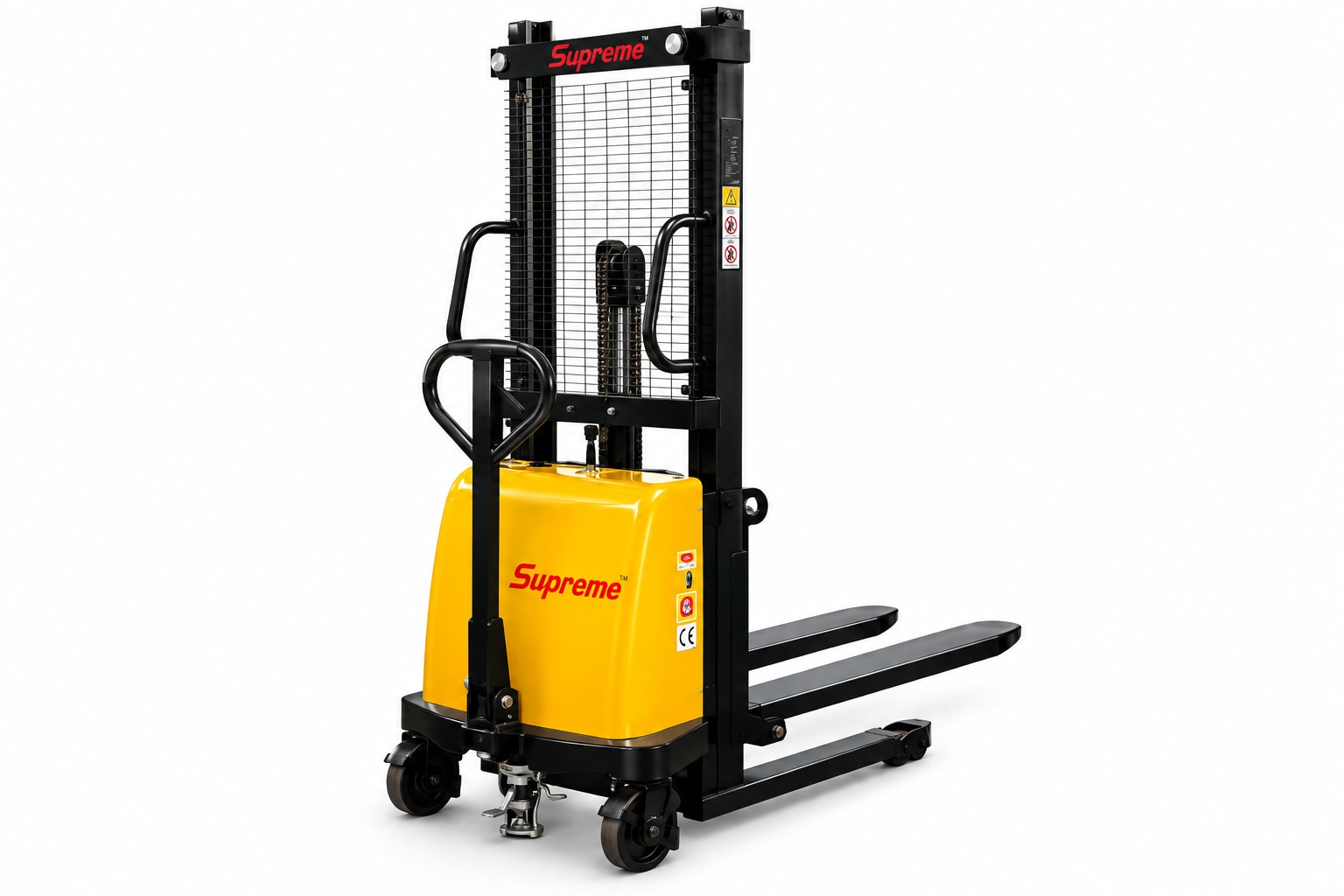 | Electric Stacker Supreme Semi Electric Stacker is a reliable and cost-effective material handling solution designed for efficient pallet lifting and movement in... View product → |
Frequently asked questions
What specifications should you request for a semi electric stacker in Jaipur?
Request the exact model code, rated capacity in kilograms, lift configuration, fork dimensions, overall dimensions and turning requirements in writing.
How do you match a semi electric stacker to your warehouse?
Compare fork length and width with your pallet openings, then check mast height, lowered height, door clearance and aisle width.
Are all semi electric stacker functions powered?
Ask whether lifting, travel and braking are powered separately; a semi electric model may use electric lifting while travel remains manual.
What equipment should the quotation include?
Confirm the battery type and capacity, charger, forks, controls, safety devices and any delivery, installation or operator-training inclusions.
Keywords