The right choice depends first on how your goods arrive: palletised loads that must be weighed repeatedly favour a weighing pallet truck, while cartons, bins, loose packages, and irregular items usually suit a platform trolley. By comparing load compatibility, weighing workflow, floor conditions, operator effort, ownership cost, and service needs, you can select equipment that fits your Jaipur facility rather than relying on capacity alone.
Key takeaways
- Choose a weighing pallet truck for standard pallets needing lift-and-weigh handling.
- Choose a platform trolley for cartons, bins, tools, and irregular loads.
- Check capacity, fork dimensions, scale accuracy, battery life, wheels, and brakes.
- Compare service response, spare parts, calibration support, and total ownership cost.
Which machine fits your load and daily movement pattern?
Choose a weighing pallet truck for standard pallets that need lifting and weighing near receiving, dispatch, storage, or transfer routes. Choose a platform trolley for cartons, bins, tools, components, loose packages, and irregular loads moving horizontally without pallet entry. That is the practical weighing scale pallet truck vs platform trolley in jaipur decision.
| Option | Best fit | Main trade-off |
|---|---|---|
| Weighing pallet truck | Centred, fully supported pallet loads; nearby weighing | Restricted fork entry, adequate aisle clearance, higher purchase and maintenance cost |
| Platform trolley | Mixed non-palletised loads; easy deck access | Separate floor or bench scale, more handling and recording |
A pallet truck can remove a trip to a floor scale, speeding repetitive checks. A trolley usually has fewer failure points and lower ownership complexity, but its high static load rating does not guarantee safe, easy pushing when full.
Check wheel diameter, castor arrangement, turning effort, deck deflection, thresholds, ramps, broken concrete, and operator visibility. A small-wheel trolley that works on a smooth floor can become difficult on a dock plate or uneven Jaipur yard.
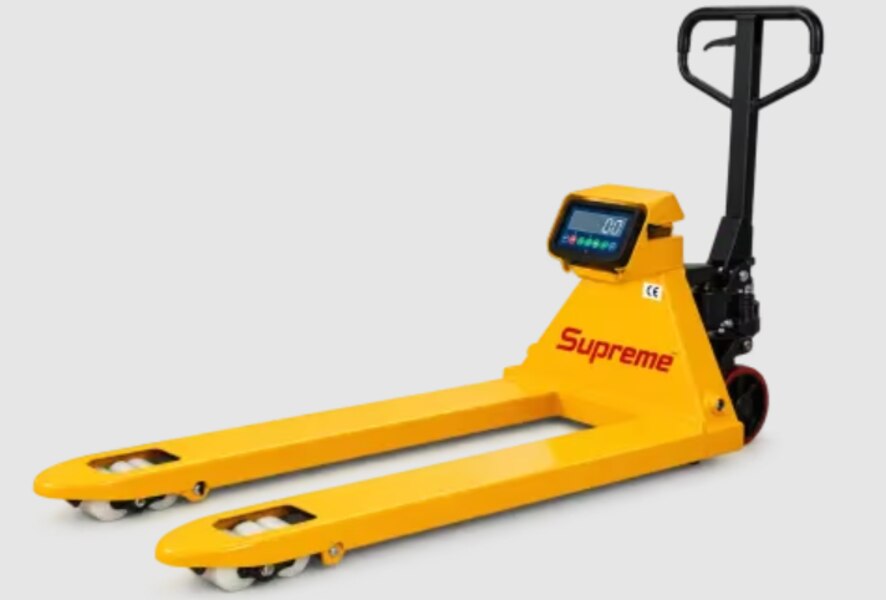
The pallet truck also needs compatible fork length, width, entry clearance, and a centred load; side loading or unsupported material can damage forks and distort readings.
For a pallet truck weighing scale comparison, include operator effort, aisle space, workflow speed, purchase price, wheel and load-cell service, battery needs, and calibration. If goods are already verified and weighing is occasional, the trolley is usually the simpler choice.
When does weighing at the pallet improve the workflow?
| Option | Weighing workflow | Best fit |
|---|---|---|
| Weighing scale pallet truck | Lifts and weighs at the movement point | Palletised receiving, dispatch, batching, and transfers |
| Platform trolley | Moves goods; weighing requires a separate scale | Cartons, bins, tools, and irregular loads |
Choose a weighing scale pallet truck in Jaipur when operators repeatedly receive goods, verify dispatches, check stock, batch materials, or transfer pallets and the weighing point lies near the route. Load cells installed between the forks and chassis measure the lifted load, avoiding a separate weighing trip.
A platform trolley creates extra handling: move goods to a floor, bench, or platform scale, wait for the weighing point, record the result, then return or continue the load. An industrial weighing pallet truck in India removes that loop, but it still needs centred, stable pallet loads and time for the reading to settle.
Gross weight is the complete load, including pallet and packaging. Tare weight is the recorded pallet and packaging weight; net weight is gross minus tare.
- Pallet type and packaging weight
- Batch or consignment reference
- Date, operator, and displayed reading
That record keeps a receiving or dispatch decision traceable months later and during an audit. Compare readability, capacity, accuracy, and repeatability separately; none proves legal-for-trade suitability. For billing, custody transfer, or commercial transactions, request legal-metrology approval, verification, sealing or stamping arrangements, and permissible error.
OIML R 76 is a reference for non-automatic weighing instruments, not automatic proof of Indian approval for your intended use.
When is a platform trolley the more practical choice?
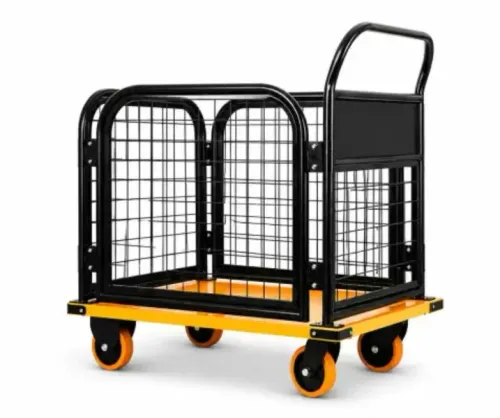
Choose a platform trolley in Jaipur for cartons, loose packages, plastic bins, tools, components, store replenishment, and short-distance horizontal movement that does not require pallet lifting.
| Option | Best fit | Main limitation |
|---|---|---|
| Platform trolley | Mixed, irregular, non-palletised loads | Needs a separate scale and cannot lift a floor-level pallet |
| Weighing pallet truck | Centred, fully supported pallet loads needing repeated checks | Awkward with unstable items and tight turning routes |
A trolley becomes the faster choice when mixed loads do not sit securely on forks. Its limitations are acceptable when quantities are already verified, weight checks happen infrequently, or pallet-truck turning would obstruct a narrow route. A low-maintenance trolley still creates queueing, double handling, and transcription work when every load must visit a separate scale.
Check the trolley before accepting its rated capacity:
- Match deck dimensions to the largest carton or bin, then keep the load distributed rather than concentrated at one edge.
- Check castor diameter, wheel material, brake or parking performance, handle clearance, and the operator’s forward view.
- Test thresholds, ramps, dock plates, outdoor surfaces, and gradients with a fully loaded trolley, not an empty demonstration unit.
A trolley only transports; it does not weigh without a floor, bench, or platform scale, and it does not lift a pallet from the floor. Choose the weighing pallet truck when those two functions occur repeatedly, not merely because its scale appears convenient.
What specifications determine safe and reliable performance?
Compare models against the site, pallet and weighing task—not the lift rating alone. This pallet truck weighing scale comparison separates mechanical fit from measurement performance.
| Specification | Check before purchase | Why it matters |
|---|---|---|
| Rated capacity | Kilograms for the actual load | Prevents overload |
| Fork fit | Length, outside width, minimum and lowered height, lift range, entry clearance | Confirms pallet compatibility |
| Movement | Turning radius and chassis clearance | Determines aisle and threshold access |
| Weighing | Readability in kilograms, accuracy class or stated tolerance | Separates display resolution from true accuracy |
| Controls | Tare, gross/net functions, visible display and overload protection | Supports repeatable records |
| Power | Battery type, charging time and runtime | Prevents work stoppages |
| Running gear | Wheel material | Matches concrete, ramps and dock approaches |
| Support | Calibration, repairs and spare parts | Limits downtime |
Use this checklist for an industrial weighing pallet truck in India:
- Confirm 2,000–2,500 kg lifting capacity and 1 kg readability do not prove weighing accuracy or legal certification.
- Weigh on firm, reasonably level ground; zero before each task, centre the load, keep forks stable and wait for vibration to settle.
- Treat ramps, broken concrete, dock plates, side loading, fork deflection, temperature changes and off-centre loads as sources of bias.
- Basic models weigh after lifting and stabilising, not while travelling. Specify dynamic-weighing capability and stated tolerances for movement weighing.
For Jaipur, provide a level weighing area. Check pinch points, gradients, parking control, handle clearance and visibility under pedestrian operation; ISO 3691-5 is a useful reference.
How should you compare ownership, service, and local supply?
Compare total operating effort, not catalogue price: a weighing scale pallet truck in Jaipur may remove separate-scale handling, queueing, and transcription, while a platform trolley in Jaipur has fewer parts to maintain.
| Option | Ownership question | Practical consequence |
|---|---|---|
| Weighing pallet truck | Load cells, indicator, cables, battery, charger, calibration settings, and optional printer or wireless hardware | Faster weighing, but indicator repairs, load-cell faults, calibration, connector protection, and spares add work |
| Platform trolley | Wheels, deck, frame, and handle; weighing requires a separate scale | Lower maintenance, but adds movement, queueing, weighing records, and double handling |
| Lead-acid battery | Charging discipline, ventilation, and periodic maintenance | Needs a suitable charging area and shift planning |
| Lithium-ion battery | Opportunity charging and less routine maintenance | Higher initial cost; confirm charger location and service support |
For dusty yards, monsoon-exposed bays, or washdown areas, obtain the actual IP rating for the display, load-cell junctions, connectors, and battery compartment. An IP-rated display does not prove that the complete truck is washdown-safe.
Ask the supplier for calibration support, response time, Jaipur service coverage, warranty exclusions, wheel-replacement arrangements, spare-part availability, and battery runtime. Also confirm whether the scale readings remain stable on your floors and whether legal-for-trade approval applies to your intended use.
Supreme Material Handling Equipment can help match fork dimensions, floor conditions, battery choice, weighing functions, and service arrangements to your workflow; still check specifications, approvals, and written service terms before ordering.
Related products
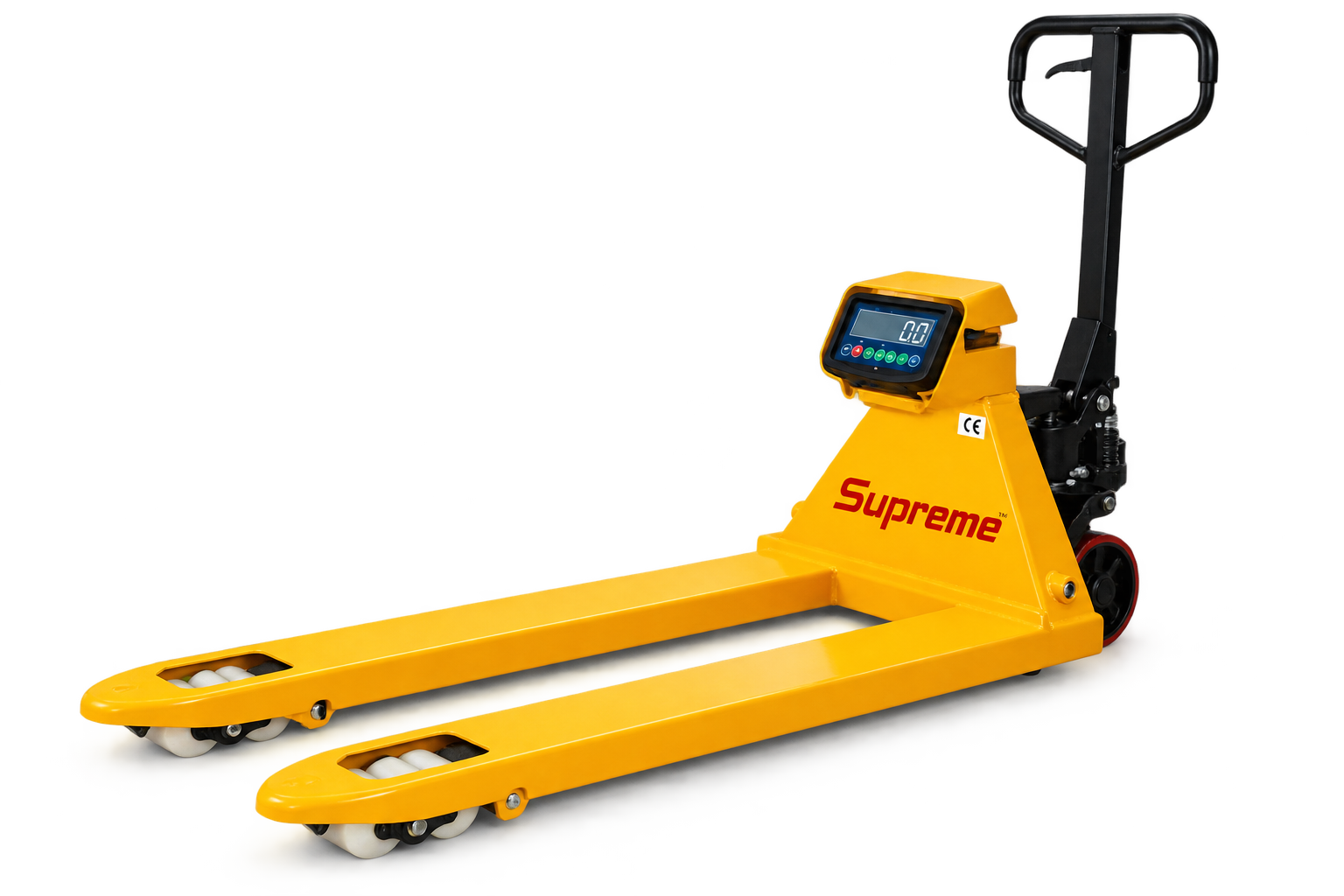 | Pallet Truck Supreme Weighing Scale Pallet Truck Supreme Weighing Scale Pallet Truck The Supreme Weighing Scale Pallet Truck is a versatile material-handling solution designed to combine pallet... View product → |
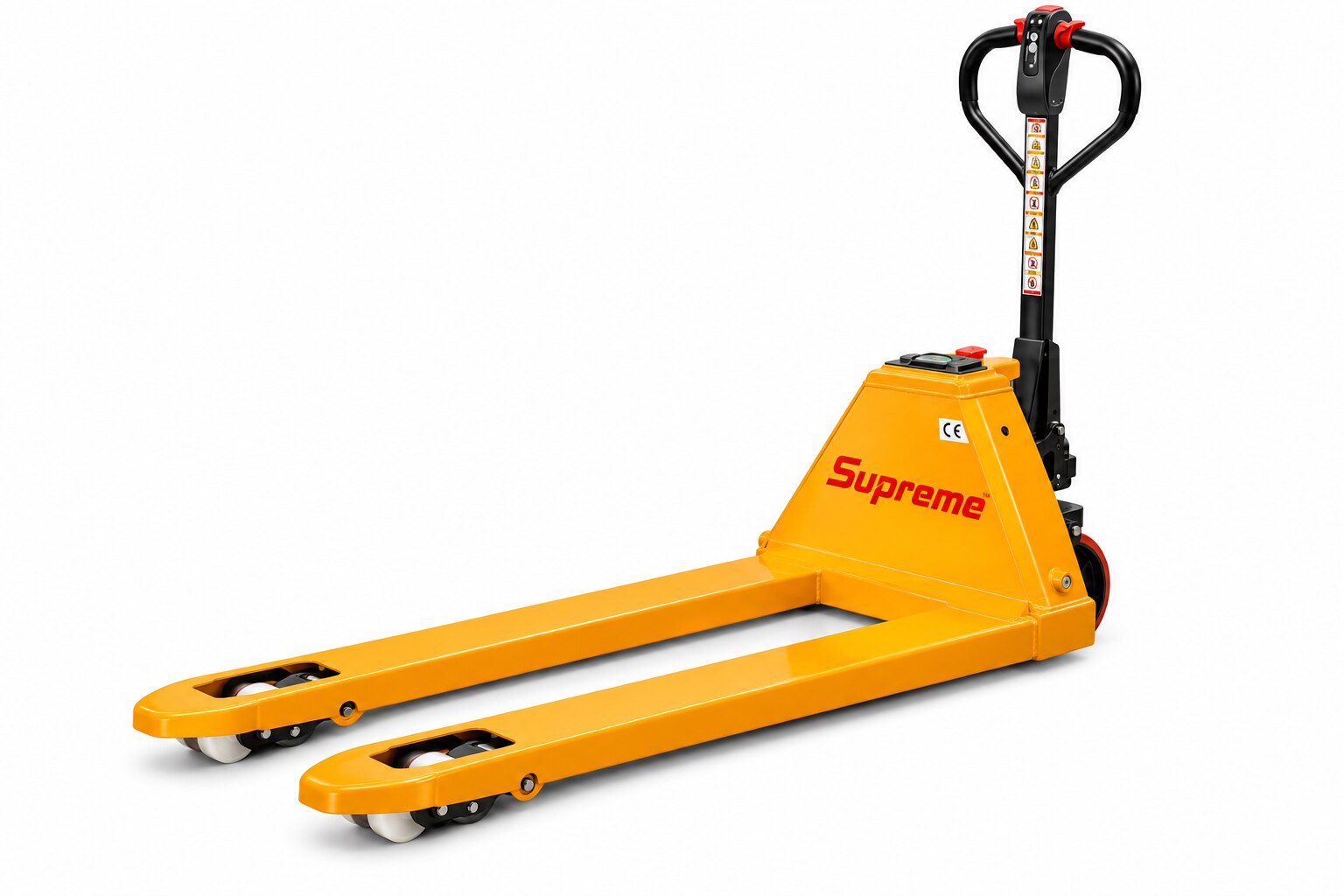 | Pallet Truck Supreme MHE The Supreme Electric Pallet Truck is a powerful, efficient, and easy-to-operate material handling solution designed to streamline pallet... View product → |
Frequently asked questions
Which machine fits standard pallets and weighing near receiving or dispatch?
A weighing scale pallet truck fits standard pallets that need lifting and weighing near receiving, dispatch, storage, or transfer routes.
When is a platform trolley more practical than a weighing pallet truck?
Use a platform trolley for cartons, bins, tools, components, loose packages, and irregular loads moving horizontally without pallet entry.
What specifications should you compare before buying?
Compare rated capacity, fork dimensions, minimum and maximum lift height, scale readability and accuracy, battery runtime, wheel material, brakes, and handle controls.
What should you check when comparing local suppliers in Jaipur?
Ask about installation, calibration support, warranty terms, spare-part availability, service response times, and the supplier’s ability to support your daily workload.
Related products
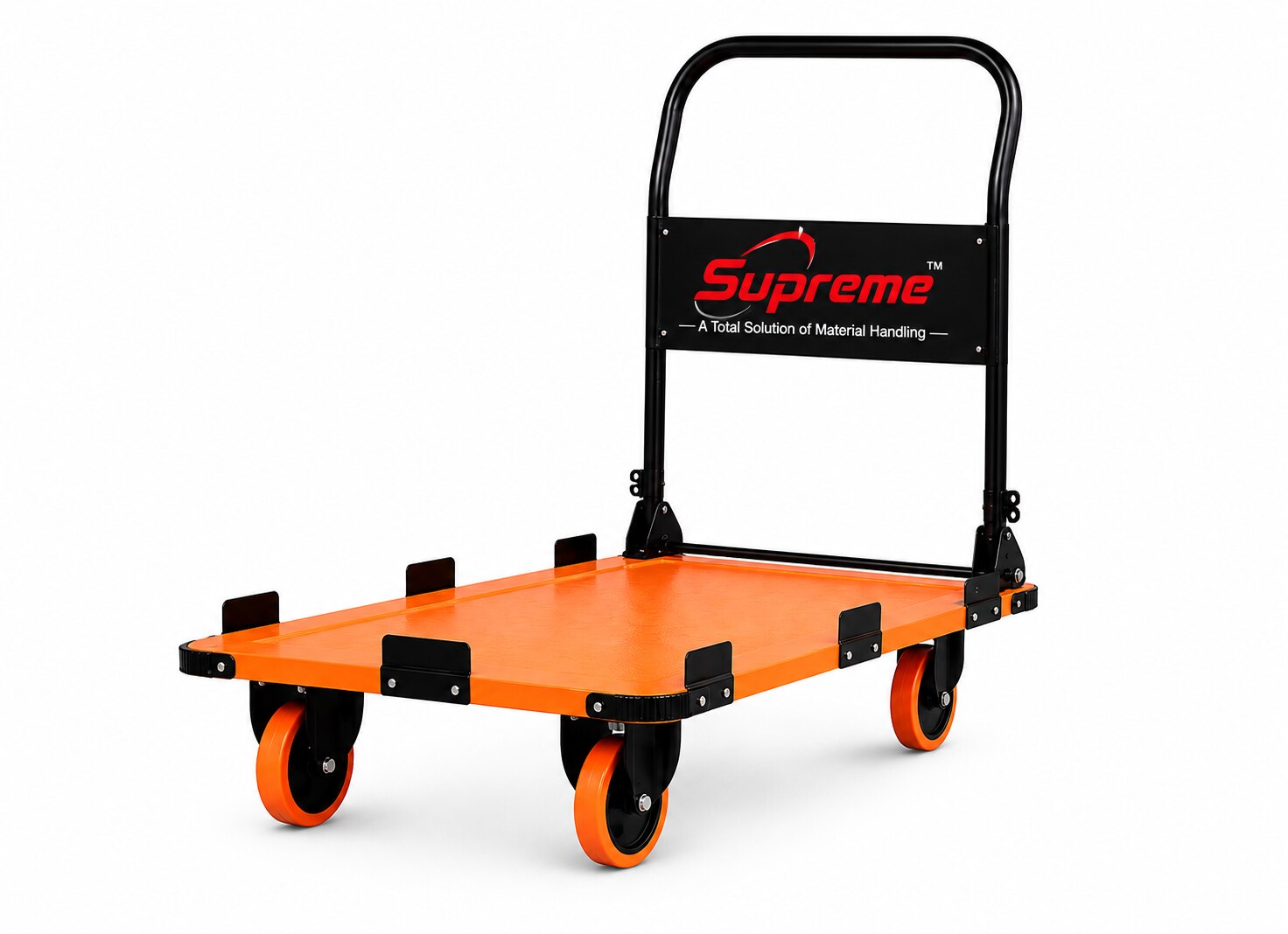 | Platform Trolley The SupremeMHE Platform Trolley is a robust and reliable material handling solution designed for the smooth, safe, and efficient movement of goods... View product → |
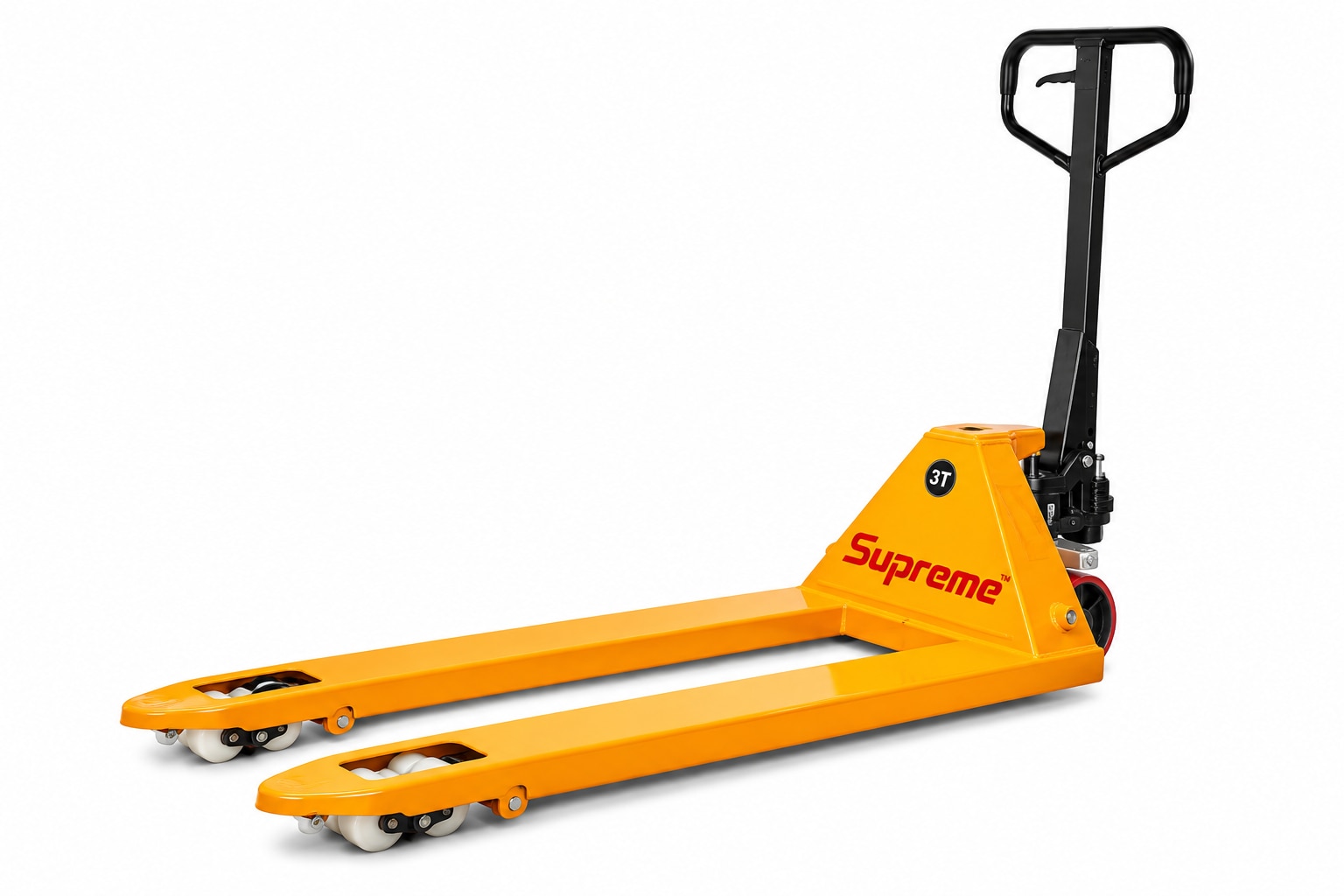 | Pallet Truck Heavy-Duty Material Handling Solution The Supreme Hand Pallet Truck is a robust and reliable material handling solution designed for the efficient... View product → |
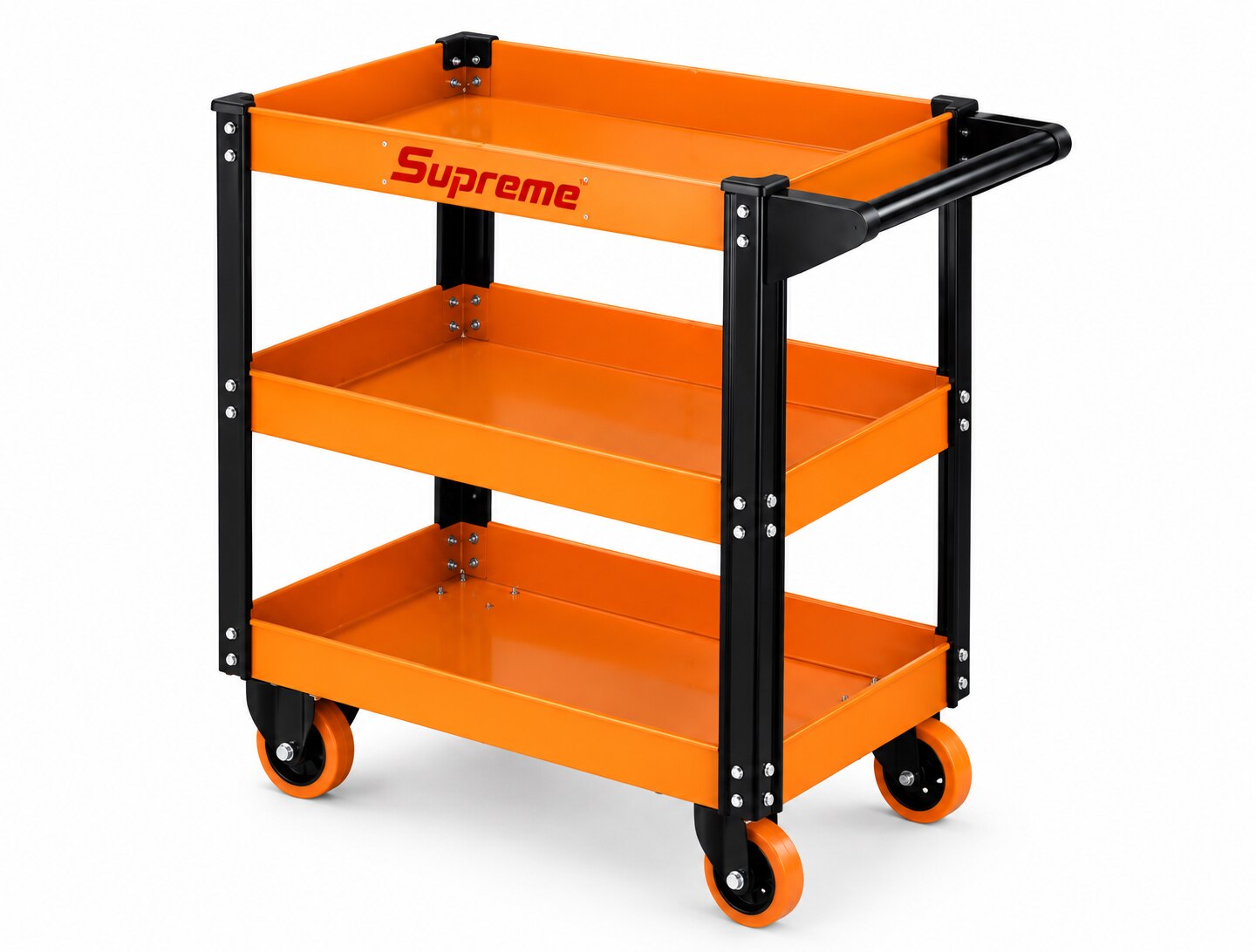 | Tray Trolley Supreme MHE The Supreme Multipurpose Tray Trolley is a strong, versatile, and space-efficient material handling solution designed for smooth... View product → |
Keywords