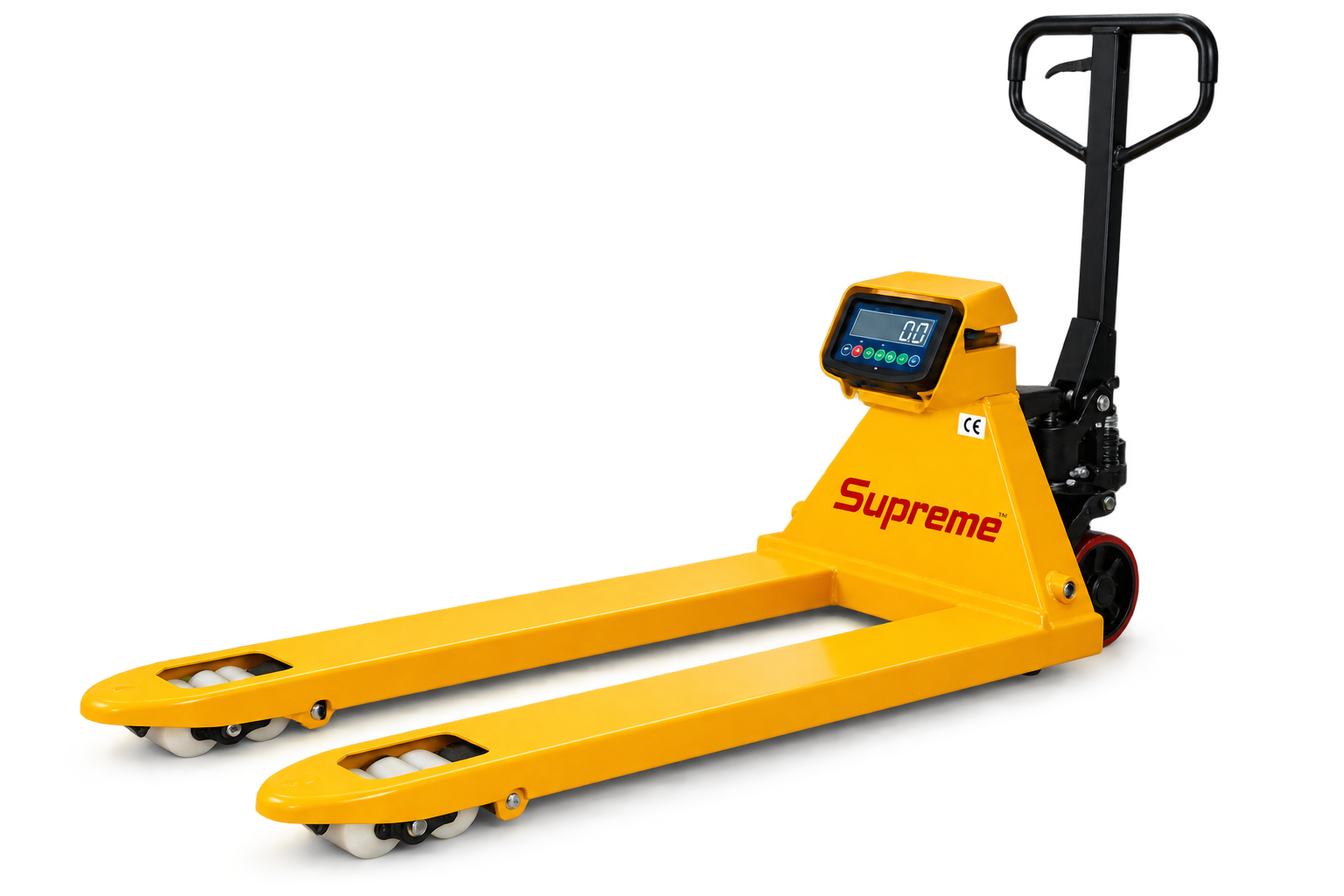
A weighing pallet truck can reduce pallet handling inside a cold store, but low temperatures, condensation, battery limits and Legal Metrology rules determine whether its readings are dependable. By comparing the equipment specification, weighing method, hygiene controls and legal documents, you can decide where it belongs in your Jaipur operation and where a separate floor scale remains necessary.
Key takeaways
- Specify the indicator, battery, load cells and hydraulics for your cold-room temperature.
- Use level, stable forks and zero checks before trusting each reading.
- Choose stainless or washable surfaces and document cleaning, calibration and pallet weights.
- Use verified equipment for billing or receiving only when it meets Indian legal-metrology requirements.
Will a weighing pallet truck work reliably in chilled and frozen rooms?
A weighing pallet truck for cold storage in Jaipur can work reliably only when every temperature-sensitive component is rated for the site. “Cold-storage compatible” is not a complete specification: a cold-rated load cell does not prove that the indicator, battery or hydraulic system will survive the same room.
Ask the supplier to provide:
- Minimum and maximum operating temperatures for the load cells, indicator, battery and hydraulic system.
- Battery chemistry, minimum discharge temperature, charging temperature, charging location, and whether the battery is removable or exchangeable.
- A written temperature-transition procedure before connecting or charging the truck after it leaves a frozen room.
Battery capacity falls in low temperatures, reducing operating time and causing voltage faults in the scale or controller. Do not run a normal lead-acid charger inside a frozen room; charge in a designated area within the charger and battery manufacturer’s temperature limits, after condensation has cleared.
A truck moving into Jaipur’s warmer air can collect condensation on the indicator, connectors and load-cell junctions. Frost, humidity and wash-down water then promote connector corrosion, load-cell drift and shortened equipment life. IP65 or IP67 addresses dust and water ingress, not condensation, wash-down chemicals or food-hygiene design.
Request the ingress-protection rating and cleaning limitations in writing, including permitted detergents, sanitisers and wash-down method. The same checks apply when comparing a pallet truck with scale for cold storage.
How should you specify and operate the truck for accurate readings?
Specify a pallet truck with scale for cold storage against the actual pallet, route and load—not its label. Confirm fork length, outside fork width, entry height, wheel position and bottom-board clearance for each footprint, including 1,200 × 800 mm and 1,200 × 1,000 mm formats.
A different bottom-board layout can prevent entry, damage the pallet or leave the load unsupported.
The scale assembly adds height and weight to the forks. Check minimum and maximum fork height, turning radius, ramp performance, door thresholds and dock geometry with the assembly installed. Do not rely on clearance figures for a basic hand pallet truck.
Use this weighing sequence:
- Place both forks fully under the pallet, with the load centred and supported.
- Stop on a level surface, away from racks, walls and other pallets.
- Lower or settle the load exactly as the truck’s instructions specify.
- Wait for a stable display before recording the weight.
Off-centre product, stretched wrapping, a tilted pallet, uneven flooring, fork flexure, shock loading, ice and debris can all change the result. Display resolution is only the smallest increment shown; request stated accuracy across the actual load range, then check working loads with traceable test weights.
If weighing while moving, require explicit dynamic-weighing capability, speed limits, motion filtering and stated accuracy. Do not assume a static scale remains accurate in travel. After the truck reaches room temperature, zero the empty forks and repeat checks at working loads.
Can it meet food-storage hygiene and traceability needs?
A weighing pallet truck for food storage in jaipur fits a hygiene-controlled operation only when its construction and cleaning method match the site. Stainless-steel or corrosion-resistant forks help, but stainless steel and IP65 or IP67 are not hygiene certification.
| Feature | Acceptable evidence | Red flag |
|---|---|---|
| Forks and frame | Sealed, cleanable surfaces with drainage and few crevices around load cells | Exposed threads, trapped water or product residue |
| Cables and wheels | Protected cable routing, food-suitable wheel material and compatible lubricants | Connectors, soft wheels or grease exposed to moisture |
| Cleaning | Written list of permitted detergents and sanitisers | No limit for wash-down water, chlorine products, caustic cleaners or standing moisture |
| Protection | Manufacturer confirms suitability for your cleaning method | IP rating offered as proof of hygienic design |
Ask how the manufacturer limits chemical and water exposure, then require that statement in writing. A scale records weight, not food identity or temperature history; traceability requires the indicator or warehouse system to capture pallet ID, product name, lot or batch number, weight, operator, date, time and receiving or dispatch event.
Use a documented check routine:
- Allow temperature equalisation.
- Inspect for frost and debris.
- Zero the empty forks.
- Compare readings with traceable test weights.
Set the interval from weighing risk and usage, not a generic calendar reminder.
When is a pallet truck with scale better than a separate floor scale?
If pallets are weighed at receiving, put-away or dispatch, a pallet truck with scale for cold storage removes the trip to a fixed floor scale. That reduces handling, cold-room door cycles and product exposure time when weighing happens frequently.
| Option | Workflow | Better fit |
|---|---|---|
| Pallet truck with scale | Move and weigh the pallet in one route | Pallet-level receiving checks, inventory control and dispatch verification when loads fit the fork capacity and pallet interface is consistent |
| Separate floor scale | Place the load on a larger, fixed platform | Irregular or oversized pallets, higher capacities, forklift weighing, and controlled placement |
A separate floor scale remains stronger when the pallet shape varies or the operator needs a large, stable platform. It also avoids forcing every load through the truck’s fork geometry.
The scale truck adds height and weight to the fork assembly. Check minimum and maximum fork height, turning radius, ramp performance, door clearance and dock geometry; manoeuvring becomes harder around racks, thresholds and tight cold-room routes.
Ask for a demonstration with your pallet, wrapping, floor surface and route. Compare reading repeatability, battery change time, cleaning effort, door clearance and service arrangements. Supreme Material Handling Equipment is worth considering as a Jaipur supplier only after that documented comparison.
The truck records weight, not pallet identity or temperature history. Keep pallet IDs, lot details and temperature records separately or connect the indicator to your warehouse system.
Related product
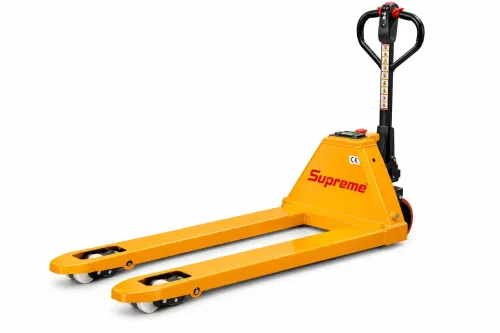
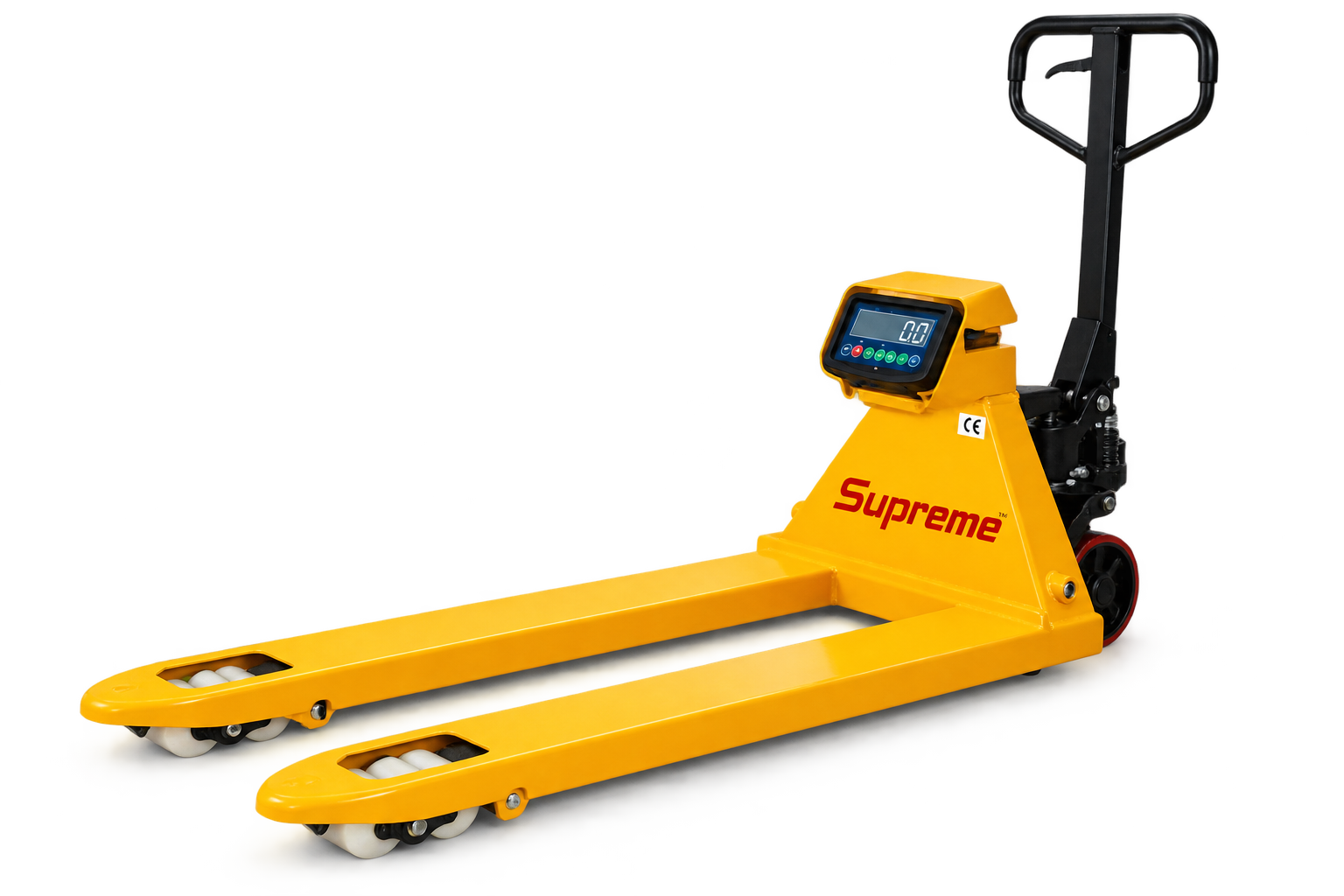 | Pallet Truck Supreme Weighing Scale Pallet Truck Supreme Weighing Scale Pallet Truck The Supreme Weighing Scale Pallet Truck is a versatile material-handling solution designed to combine pallet... View product → |
Can the reading be used for billing or commercial receiving in India?
A weighing pallet truck for food storage in Jaipur is useful for stock control, but its display is not automatically a legally accepted trade measurement.
Treat the reading as internal data until the supplier and Jaipur Legal Metrology authority confirm whether verification and stamping are required before invoicing, selling by weight or accepting a delivery on that basis.
| Purpose | Internal stock reading | Trade measurement |
|---|---|---|
| Use | Inventory, dispatch checks and pallet control | Invoices, sale by weight or receiving acceptance |
| Evidence | Operator record and routine test-weight checks | Legal Metrology approval, verification and sealing |
| Status | Operational information | Legally accepted only after the required authority checks |
For a weighing pallet truck for cold storage in Jaipur, obtain and retain:
- A current Certificate of Verification issued by the Legal Metrology Officer, showing the instrument identification, capacity, accuracy class and verification details, plus the physical verification stamp or seal where prescribed.
- The applicable Model Approval Certificate, the manufacturer’s calibration certificate and test results made with traceable standard weights. An internal display or generic supplier service note is not trade approval.
- Written confirmation of who arranges initial verification, re-verification, inspection and sealing after repair or load-cell replacement.
- A register linking the truck serial number and seal condition to pallet ID, lot number, operator, time, reading, test-weight checks, calibration interval and adjustments.
Use the reading for billing only after the authority and documents confirm that purpose. Otherwise label it internal control data; the register then provides evidence when quantities are disputed.
Frequently asked questions
Will a weighing pallet truck work reliably in chilled and frozen rooms?
Yes, if the load cells, indicator, battery and hydraulic system are all rated for the room’s temperature, condensation and washdown conditions. A cold-rated load cell alone is not enough.
How should you specify and operate a weighing pallet truck for accurate readings?
Confirm the operating temperature range, capacity, readability, battery performance and ingress protection. Check zero before weighing, place the load evenly on the forks, stop on a level surface and keep the pallet still during the reading.
Can a weighing pallet truck meet food-storage hygiene and traceability needs?
Choose cleanable construction, protected wiring and surfaces that do not trap water or food residue. Record equipment identification, cleaning, inspection, calibration and each relevant pallet or batch reference.
When is a pallet truck with scale better than a separate floor scale?
Use a pallet truck with scale when you need to weigh during short-distance pallet movement and want to avoid an extra transfer. Choose a floor scale when you need higher weighing control, fixed positioning or frequent verification.
Can the reading be used for billing or commercial receiving in India?
Only use it for trade transactions after confirming that the instrument is approved, verified and stamped or certified as required for the intended commercial use under Indian legal-metrology rules. Keep the verification record with receiving documents.
Keywords