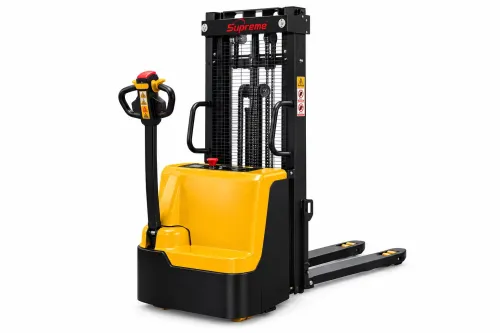
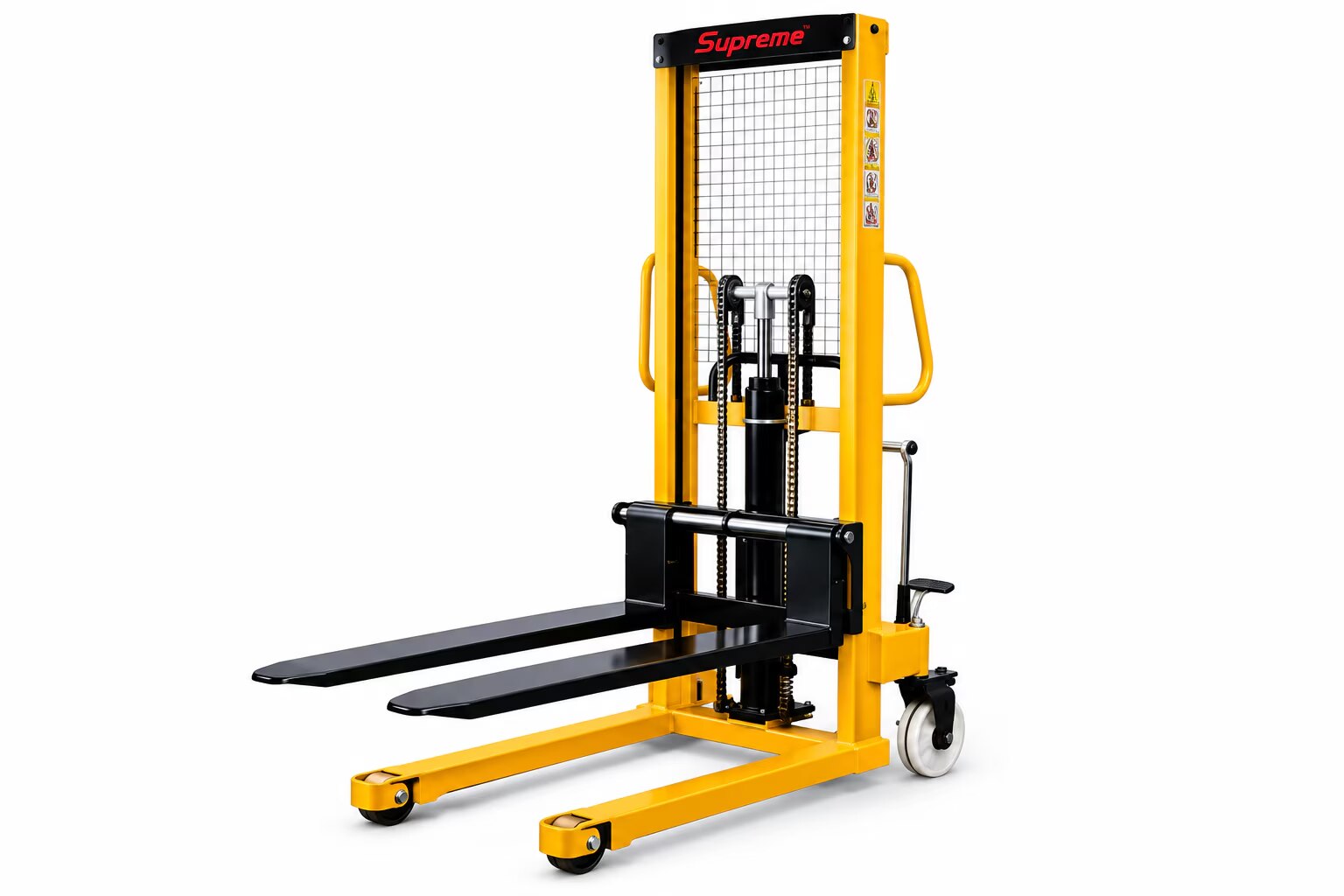
A manual stacker quotation rarely answers the questions that determine whether the machine will fit your pallets, clear your racks and survive the route across your warehouse. By checking the capacity chart, package list, site conditions and delivery documents, you can turn a broad product description into a purchase order with clear expectations.
Key takeaways
- Match lift height and capacity to your pallets, racks and aisle width.
- Ask for rated capacity, load-centre distance and residual capacity at height.
- Confirm what the quoted manual stacker package includes before comparing prices.
- Document frame, forks, hydraulics, wheels and accessories during delivery inspection.
Match the stacker to your Jaipur warehouse before requesting a quote
A manual stacker suits a Jaipur warehouse that lifts and positions pallets at a steady but moderate frequency, works on level floors, and does not need long-distance transport or powered travel.
It is a poor choice for high-throughput loading, ramps, broken concrete, frequent outdoor use or aisles so tight that the machine cannot turn without striking racks.
Provide these manual stacker buyer details in jaipur before asking for a quote:
- State the pallet length, width and entry direction, plus the maximum pallet weight and full load dimensions.
- Give the required stacking height, lowest fork height and the highest rack beam or storage position.
- Measure the narrowest aisle, doorway and turning space; include rack-end clearances and any columns or dock edges.
- Describe the floor: smooth concrete or damaged surface, level changes, expansion joints, wet areas and slopes.
- Report daily lift frequency, travel distance and whether the stacker will operate indoors, outdoors or across both.
- Ask the supplier to quote the exact model, rated capacity, maximum lift, fork length and outside fork width, mast height, overall width, turning radius, wheel material and hydraulic pump type.
- Request a load chart showing capacity at each lift height and load centre. A headline capacity alone cannot prove the machine is safe at maximum lift.
Send photographs of the aisle, floor and rack location with the measurements. This prevents a low quotation for a stacker that cannot enter, turn or lift safely at your site.
Record the specifications that decide usable lifting capacity
Do not accept “500 kg manual stacker” as a specification. A manual stacker purchase checklist in jaipur should record the exact model, rated capacity, maximum lift height and the load-centre distance used for that rating.
Request these figures on the quotation:
- Rated capacity in kilograms and safe capacity at maximum lift
- Maximum lift height in millimetres, with the reference point stated: fork top, fork bottom or another datum
- Lowered fork height, fork length and outside fork width
- Mast type, mast height when lowered, overall width and turning radius
- Hand-pump, foot-pump or winch-operated lifting mechanism
- Wheel material, warranty period and warranty exclusions
The quotation must include a load chart, not one capacity number. Check the plate at delivery against the quoted model and figures; an unreadable or mismatched nameplate is grounds to pause acceptance.
| Figure | What it means | What to request |
|---|---|---|
| Rated capacity | The headline load limit at the manufacturer’s specified load centre and conditions | Capacity in kilograms plus load-centre distance |
| Safe capacity at maximum lift | The permitted load when the forks reach the stated maximum height | Load-chart value for that height and load centre |
| Usable rack height | The height you can actually achieve after allowing for pallet thickness, load height, top clearance and mast obstruction | Fork reference point, clearance allowance and required beam height |
A 500 kg rating does not prove a 500 kg load is safe at full lift. Use the load-chart value for your pallet and centre of gravity.
Separate the manual stacker package from chargeable extras
A written quote should identify the exact lifting arrangement, not merely say “manual.” Hand-pump hydraulic, foot-pump hydraulic, and winch-operated stackers require different effort, parts and maintenance.
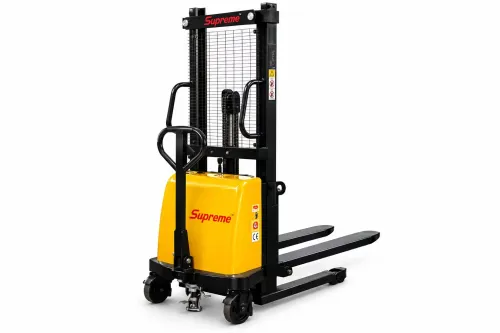
For manual stacker package contents in Jaipur, require the model, forks, mast, hydraulic pump or winch, tiller or control handle, load backrest, steering and load wheels, basic assembly hardware, operating manual and warranty document.
| Item | Include in the quoted package | Confirm separately |
|---|---|---|
| Stacker equipment | Assembled or partly assembled frame, mast, forks, handle, wheels and lifting mechanism | Final assembly, installation tools and commissioning |
| Power-related items | Battery and charger only if the model uses them and the quote names them | Battery, charger, weighing scale or electrical accessories |
| Handling at site | Freight to your Jaipur address only if stated | Unloading, ramps, placement and damage responsibility during unpacking |
| Support | Warranty period, exclusions and operator demonstration if promised | Training duration, preventive-maintenance visits and service response time |
| Future maintenance | Hydraulic oil specification and parts list | Seals, chains or cables, wheels, rollers, fasteners and delivery time for replacements |
Ask the supplier to mark every absent item as excluded rather than leaving the wording vague. Confirm GST, transit insurance, delivery lead time, and whether a technician will test lifting and lowering at handover.
Also record Jaipur service coverage and the source of consumables; a low price loses its value when a wheel, hydraulic seal or mast roller must come from another city.
Check pallets, aisles, racks and floor conditions before ordering
A stacker works safely only if its forks, capacity, mast and wheels match the pallet and the route. Measure the site before ordering; a machine that lifts the load but cannot turn, clear the rack or roll smoothly is the wrong machine.
1. Record the pallet’s length, width, thickness and entry direction. Check that the fork length supports the pallet without excessive overhang, and that the outside fork width fits its openings. Include the maximum load weight and load dimensions, not just the pallet rating.
2. Calculate the real load centre, measured from the fork face to the load’s centre of gravity. A long load or a load positioned forward of the stated centre reduces usable capacity. Request a capacity-versus-lift-height chart rather than relying on the largest number on the nameplate.
3. Measure the rack beam or shelf height, then allow space for pallet thickness, load height, top clearance and any mast obstruction. Ask whether the quoted lift height is measured to the fork top, fork bottom or another point; advertised maximum lift is not automatically usable rack clearance.
4. Measure the narrowest aisle, turning space and obstructions, including columns, doors and rack guards. Compare these dimensions with the stacker’s overall width and turning radius.
5. Inspect the route for slopes, ramps, dock plates, thresholds, expansion joints, drainage channels, cracks and loose surfaces. Manual stackers need level floors; defects increase push force, damage wheels and destabilise loads even below rated capacity. Specify wheel material for the actual floor.
Accept the machine only after a documented delivery inspection
Do not sign acceptance while the transporter is still waiting unless the unit passes a physical and functional check. Photograph the crate, nameplate, forks, mast and any damage, then record the result on the delivery note before the vehicle leaves.
- Match the nameplate to the purchase order: exact model, rated capacity, maximum lift, lowered fork height, fork length and width, mast type, wheel material and lifting mechanism.
- Count the forks, mast, hydraulic pump, handle, load backrest, wheels, supplied tools and any battery or charger listed.
- Check forks for bends, cracks and uneven tips; inspect welds, frame members, chains or cables and guards for damage.
- Look beneath the unit and around hydraulic connections for oil leakage.
- Test smooth lifting, controlled lowering, steering, wheel movement and the parking brake or brake function without a load, then follow the manufacturer’s operating limits for any loaded test.
- Obtain the operating manual, maintenance guidance, warranty document, invoice, delivery record and available test or inspection certificate.
A verbal assurance that the machine is “heavy duty” cannot replace a rated nameplate or load chart. Supreme Material Handling Equipment’s written quote should identify the supreme manual stacker for included equipment in jaipur, including freight, unloading, assembly, commissioning, demonstration, GST, transit insurance and installation tools.
It should also state warranty exclusions, spare-parts support, maintenance intervals and training. Those details prevent “delivered” from becoming an argument over who pays when unpacking reveals damage.
Related product
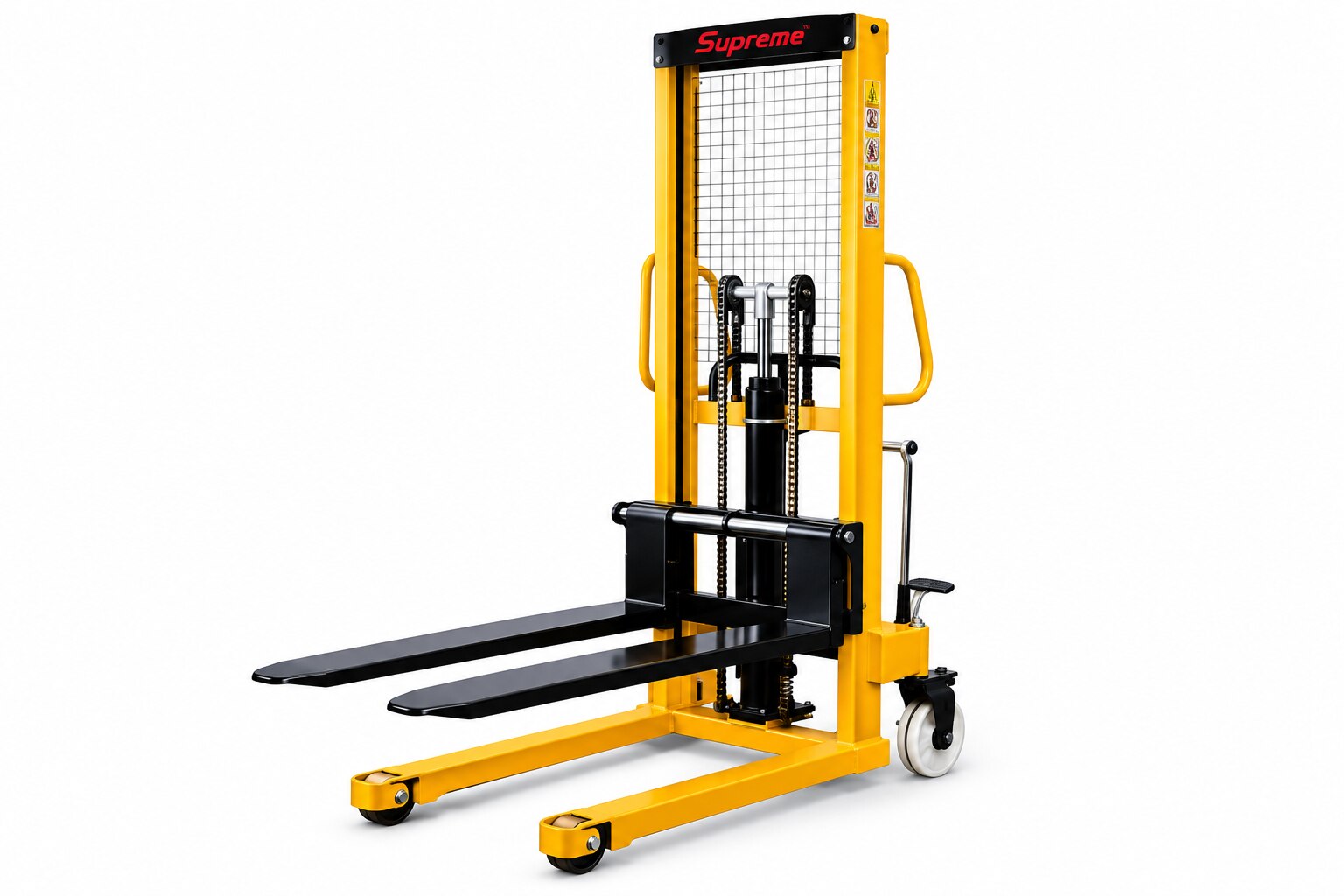 | Manual Stacker Heavy-Duty Hydraulic Pallet Stacker The Supreme Manual Stacker is a reliable and heavy-duty material handling solution designed for efficient... View product → |
Frequently asked questions
How do I match a manual stacker to my Jaipur warehouse?
Check your pallet dimensions, rack height, aisle width, floor levelness and lifting frequency before requesting a quote.
Which specifications decide a manual stacker's usable lifting capacity?
Record rated capacity, maximum lift height, load-centre distance, fork dimensions and residual capacity at the required height.
What should I confirm in a manual stacker package quote?
Separate the base stacker from chargeable extras, then obtain a written list of included forks, wheels, safety features and accessories.
What should I inspect when the manual stacker arrives?
Compare the delivered machine with the order, inspect the frame, forks, hydraulics, wheels and safety parts, and record defects before acceptance.
Keywords