A headline load rating does not tell you whether a truck will enter your pallets, clear your dock, climb your ramp or finish a shift on one charge. By collecting site measurements, operating data, battery requirements and acceptance tests before requesting quotations, you can compare equipment that fits the actual Jaipur workflow rather than catalogue language.
Key takeaways
- Record load weights, travel distances, gradients and daily pallet moves.
- Measure aisle width, turning space, dock heights and floor conditions.
- Match truck controls, forks and battery capacity to the movement pattern.
- Put capacity, trial results, warranty and service response in the purchase order.
What operating data should you collect before requesting quotations?
Build the quotation brief around the load and job, not advertised motor power. These electric pallet truck order requirements in Jaipur reveal whether a headline 2,000 kg rating suits your actual duty cycle.
- Record average and maximum load in kilograms, load centre, pallet dimensions and construction. State whether pallets are 1,200 × 800 mm, 1,200 × 1,000 mm or another format, and identify open-bottom or closed-bottom pallets because entry clearance, fork taper and wheel arrangement can differ.
- Request rated capacity at the stated load centre, such as 600 mm, and capacity for long, uneven or raised loads. Specify fork length, fork outside width, minimum fork height, maximum lift height, overall length, turning radius and truck weight.
- Record operating hours per shift, pallet movements, average and maximum travel distance, loaded and unloaded ramp gradients, required travel speed and charging opportunities. A 24 V battery label does not prove shift completion.
- State whether dispatch requires weighing. Request accuracy, calibration or verification method, display readability, tare procedure and performance on uneven floors or off-centre loads.
- Add cold-room temperature, food or pharmaceutical hygiene, outdoor-apron, dust and monsoon exposure requirements. Ask for permitted conditions and electrical ingress protection.
| Compare | Record in the brief | What it prevents |
|---|---|---|
| Rated capacity | Capacity at your load centre | A 2,000 kg rating hiding reduced capacity |
| Weighing truck | Accuracy and verification method | Unusable dispatch weights |
| Duty cycle | Hours, movements, distance and gradients | Battery failure before shift end |
How do you prove that the truck will fit the warehouse?
Prove fit with a loaded site survey, not a catalogue turning-radius figure. Measure the narrowest aisle with the pallet on the forks, including the required pedestrian clearance, then record the swept path beside racks and at every turning point.
Measure the dock approach, loading-bay opening, doorway width, goods-lift length and width, dock-plate clearance, and pallet-entry clearance. Inspect expansion joints, potholes, thresholds, floor flatness, ramps and dock levellers; a level-floor trial can hide poor performance at a damaged threshold.
Wheel choice changes the result:
| Option | Benefit | Trade-off |
|---|---|---|
| Small wheels | Reduce truck dimensions | Transmit more shock over joints and potholes |
| Larger drive/load wheels | Improve threshold crossing | Increase turning space and price |
Compare wheel diameter with the largest joint or threshold the truck must cross. Obtain loaded and unloaded gradeability, traction and braking data for every vehicle ramp, dock leveller or sloped approach.
For dusty warehouses, outdoor aprons and monsoon-exposed docks, specify the ingress-protection rating and permitted operating conditions for electrical components. An IP rating does not approve pressure washing, standing water or heavy dust exposure. Measure a charging location with safe access, required ventilation and compatible electrical supply.
These checks turn electric pallet truck details in Jaipur into measurable fit criteria. In refrigerated rooms, add temperature range, condensation precautions, washable construction, corrosion resistance, wheel material and battery suitability; never assume a standard warehouse truck is cold-room ready.
Which truck configuration matches your movement pattern?
Match the truck to the work pattern, not the advertised motor power. Choose walk-behind when routes are short, pallet movements are intermittent and the operator leaves the tiller for picking, scanning or dock tasks. Choose ride-on when routes are long, movements are frequent, shifts are extended and repeated walking consumes productive time.
| Option | Strength | Cost or limitation |
|---|---|---|
| Hand | No charging; lowest purchase cost | More physical effort and lower productivity over distance |
| Semi-electric | Powered travel with manual functions retained | Less travel effort, but manual handling remains |
| Fully electric | Lower operating effort and noise | Battery, charger, controller and service requirements |
Compare maintenance access, wheel wear, charging downtime and operator training. “Powerful” and “easy to operate” are not selection evidence.
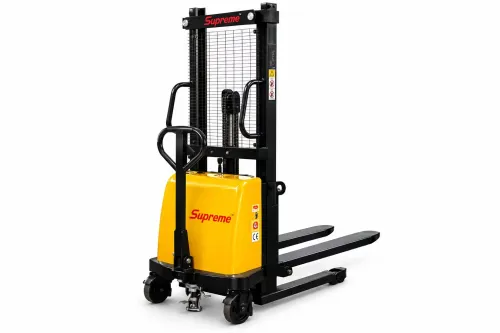
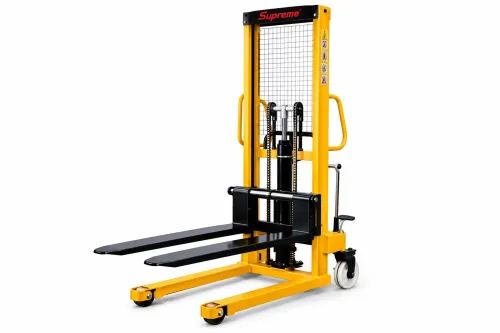
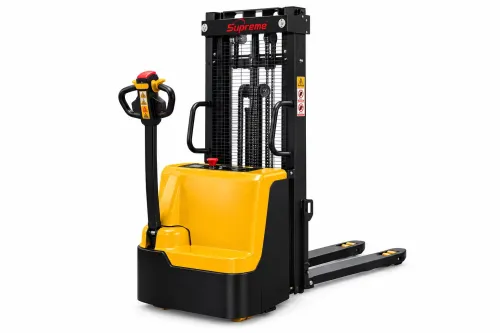
Separate floor-level transport from vertical storage. An electric pallet truck handles horizontal movement and small lift ranges; use a semi-electric or fully electric stacker for rack, shelving or elevated positions. Confirm lift height, rack-beam height and mast clearance before substituting one.
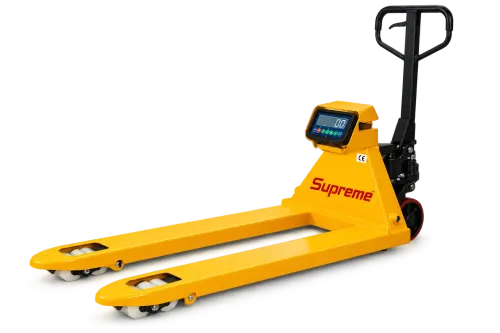
If dispatch needs weights, compare an integrated weighing truck with a conventional truck plus floor scale. Require off-centre-load accuracy, uneven-floor accuracy, display readability, tare procedure and calibration or verification method.
Use this electric pallet truck buying checklist in Jaipur before choosing:
- Confirm the load centre, pallet dimensions, fork entry, lift range and clearance.
- Compare actual route length, movement frequency, shift duration and charging opportunities.
- Inspect wheel wear, joint and threshold performance, service access and operator training needs.
- Specify whether weighing accuracy holds on uneven floors and off-centre loads.
What battery and charging specification will complete the shift?
1. Ask each supplier to state the battery chemistry, nominal voltage, ampere-hour or usable-energy rating, charger input requirements, charge time, connector type, battery-removal method and battery-management system. “Maintenance-free battery” is not a specification.
2. Do not treat 24 V as proof of shift capacity. Match the battery to pallet movements, average and maximum load, travel distance, gradients and operating hours per shift. Record charging opportunities, then decide whether you need a spare battery or a battery-exchange process.
3. Lead-acid batteries need a designated charging area, ventilation, electrolyte-maintenance procedures and enough charging time. Lithium-ion batteries reduce routine watering and support opportunity charging, but need a compatible charger, battery-management system and thermal controls.
4. Check the connector and charger plug against the Jaipur site’s electrical supply. Identify who supplies replacement batteries and chargers, and specify the battery low-voltage cut-out. Keep chargers away from traffic, rain and heat sources, with clear access for isolation and inspection.
5. Define cleaning and inspection for dust on electrical connectors, high ambient heat and monsoon moisture. Ask for permitted operating conditions and the ingress-protection rating; do not assume the product name covers pressure washing, standing water or heavy dust.
Require a demonstration showing loaded travel through the actual duty cycle, not an unloaded run after a full charge.
What must the quotation, trial and purchase order guarantee?
Make the purchase order the acceptance standard, not a record of broad promises. Request a line-by-line quotation that repeats:
- Rated capacity at the agreed load centre
- Pallet dimensions, fork length, fork outside width and minimum fork height
- Maximum lift height, turning radius, overall truck length and truck weight
- Travel speed, gradeability, battery chemistry, voltage, capacity, charger and connector
- Warranty term, exclusions and every included accessory
Run a loaded site trial before signing acceptance.
| Test | Acceptance evidence | Where to test |
|---|---|---|
| Emergency reverse or belly-button protection | Truck stops or reverses safely when the control is pressed | With a loaded pallet |
| Electromagnetic or regenerative braking | Truck slows and stops without excessive roll | Aisle and ramp |
| Parking brake | Truck remains stationary under the stated load | Ramp |
| Tiller controls, horn and emergency isolator | Each control responds correctly and power cuts off when isolated | Operating area |
| Battery low-voltage cut-out | Truck limits operation before damaging discharge | End-of-shift simulation |
| Site fit | No collision or unsafe shock | Thresholds, joints, ramps, doorways, racks and charging location |
Put commissioning, operator training, preventive-maintenance intervals, breakdown response time, warranty exclusions and service location in the purchase order. Name the Jaipur stock point for traction wheels, batteries and electronic controllers. Downtime can exceed a lower purchase price.
If comparing an electric pallet truck logistics company in Jaipur, give every bidder identical duty assumptions and tests. Supreme Material Handling Equipment belongs in that comparison only when its quotation states these measurable terms. Accept the truck after the loaded tests, manuals, charger instructions, battery records and service contacts are handed over.
Related product
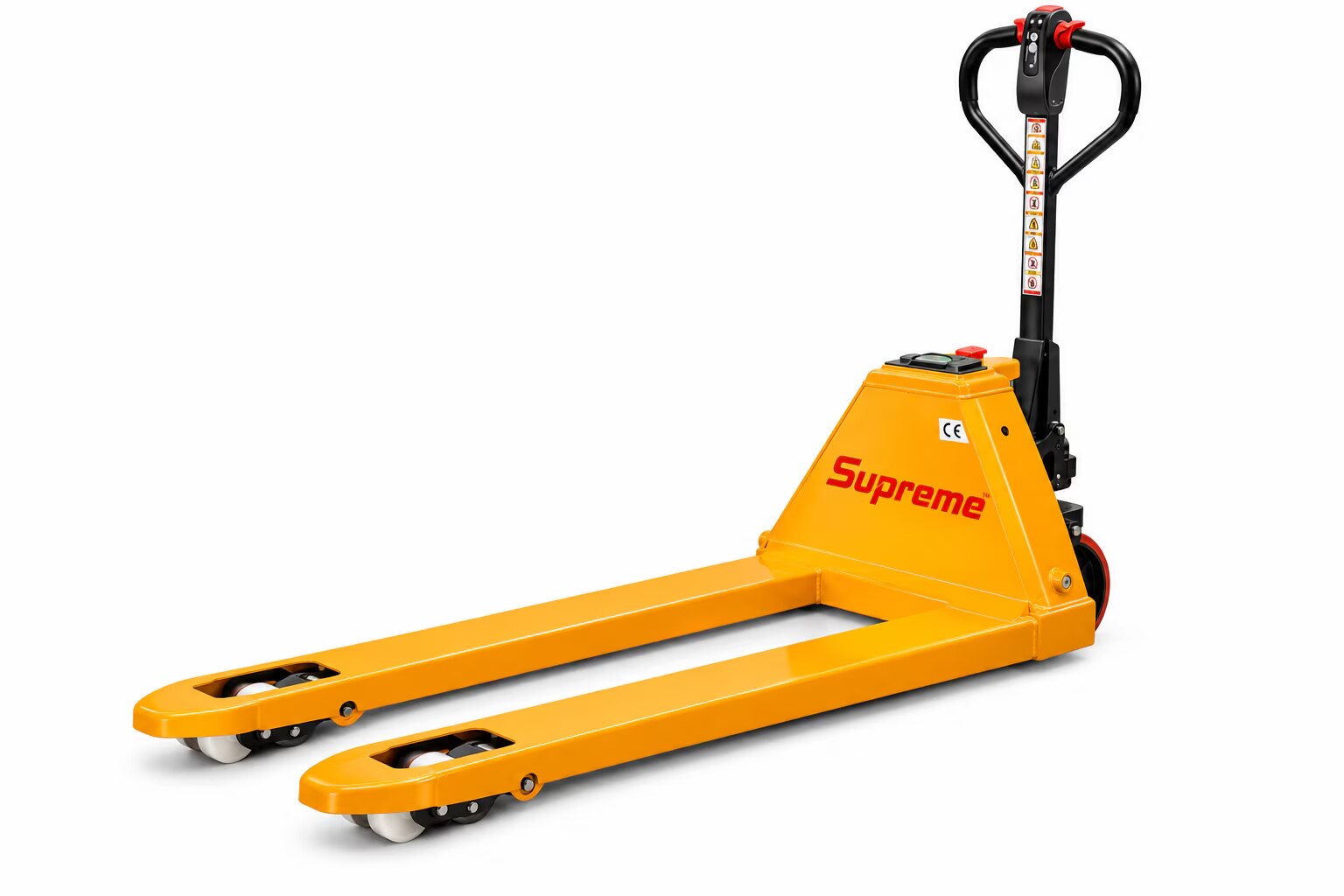
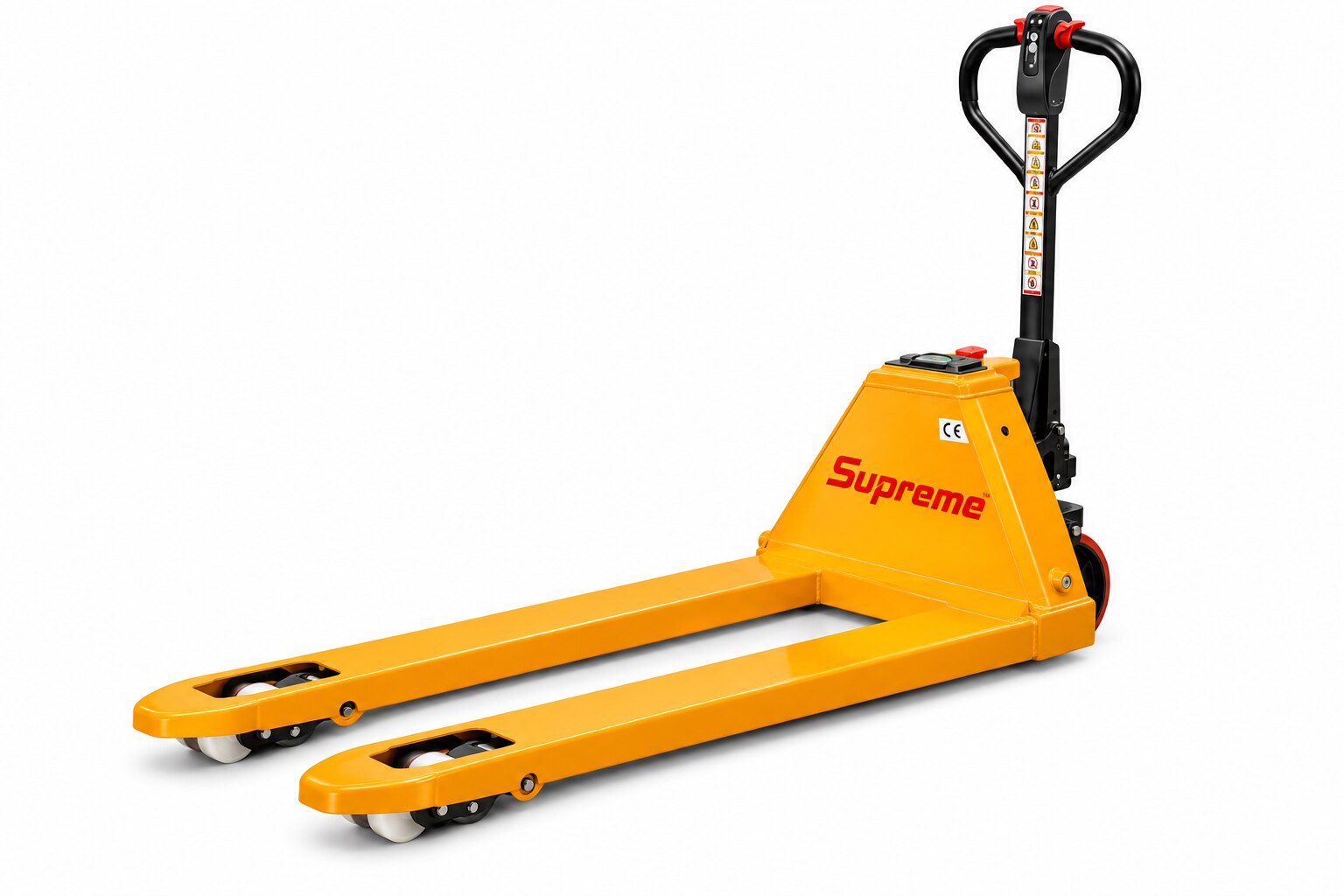 | Pallet Truck Supreme MHE The Supreme Electric Pallet Truck is a powerful, efficient, and easy-to-operate material handling solution designed to streamline pallet... View product → |
Frequently asked questions
What operating data should a Jaipur logistics company collect before requesting quotations?
Record the heaviest and average loads, pallet dimensions, daily moves, travel distance, gradients, shift length, loading frequency, floor condition and operating temperature. Include whether the truck will work inside trailers, cold rooms, ramps or shared pedestrian areas.
How can you prove that an electric pallet truck will fit the warehouse?
Measure the narrowest aisle, doorway, ramp, dock plate, rack opening and turning area. Compare those measurements with the truck’s overall length, width, fork dimensions, turning radius, lift height and ground clearance on the supplier’s drawing.
Which electric pallet truck configuration matches a movement pattern?
Choose a walk-behind model for short, controlled moves; a platform or rider model for longer travel; and a longer-fork configuration only when pallet size requires it. Check load centre, steering controls, braking, visibility and pedestrian separation before choosing.
How do you confirm that the battery and charger will complete the shift?
Give the supplier shift hours, travel intensity, load profile, charging windows and available electrical supply. Request the battery voltage and capacity, charger rating, charging time, connector type, battery-change method and operating instructions in writing.
What must the quotation, trial and purchase order guarantee?
Specify rated capacity at the stated load centre, dimensions, speed, lift range, battery and charger details, safety equipment, warranty coverage, delivery scope, operator training, spare parts and service response. Record the trial route, load, cycle time and acceptance conditions.
Keywords