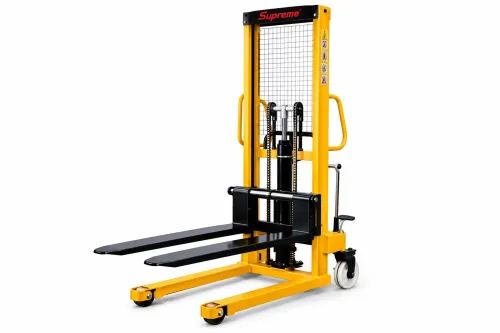
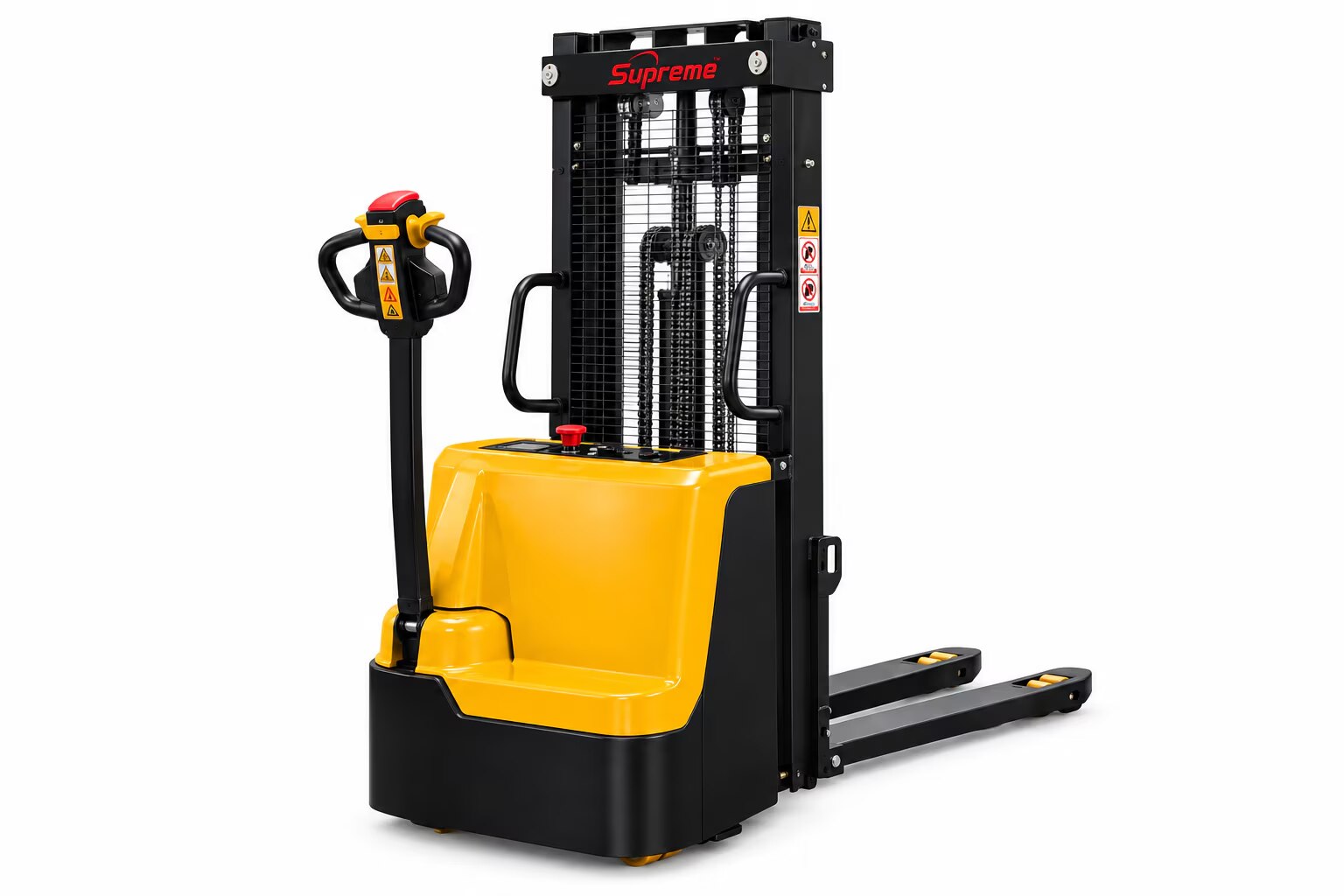
A quotation that says “1,000 kg electric stacker” leaves out the details that determine whether the truck will fit your aisles, lift your actual load and complete a shift safely. Use the checks below to specify the machine, battery, charging point, site conditions and delivery tests before you compare suppliers in Jaipur.
Key takeaways
- Check rated capacity at your required lift height and load centre.
- Measure aisle width, floor condition, mast height and turning clearance.
- Match battery capacity and charging time to every shift and duty cycle.
- Specify safety features, documents and acceptance tests before placing the order.
Confirm the truck’s real capacity, not its headline rating
A quotation is not comparable until it proves the truck’s capacity at your actual lift height. A “1,000 kg” headline rating can apply only at a low mast position, while the permitted load falls at maximum height.
Use this fully electric stacker buying checklist in Jaipur:
1. Confirm that both traction and lifting are electrically powered. An electric lift with manual pushing is not a fully electric stacker.
2. Give the supplier your pallet weight, load dimensions, load-centre distance and required lift height. The load centre is measured from the fork face to the load’s centre of gravity; a longer or uneven load reduces stability.
3. Require the quotation to state rated capacity, load-centre distance, mast type, maximum lift height, free lift and residual capacity at each required height. Ask for the manufacturer’s residual-capacity chart, not a capacity claimed only in sales copy.
4. Request the truck’s maximum raised height, mast height when lowered, fork dimensions, ground clearance, overall length with forks and machine weight. Check these against your rack beam height, door openings, dock edges and floor limits.
Have the supplier test the quoted model with your actual pallet in the narrowest aisle. The delivered truck must carry a permanent load chart or residual-capacity plate; a nominal figure on the quotation cannot replace it.
Also disclose Jaipur site conditions, including dust, monsoon moisture and outdoor loading, because a clean-indoor truck may not suit an exposed yard.
Measure the machine against your aisles, floors and loads
A stacker that fits the aisle can still fail at the doorway, lift, dock or elevator. Measure the narrowest route, not the average warehouse space, and compare those figures with the truck’s loaded dimensions.
For fully electric stacker details in Jaipur, request these figures on the quotation:
- Overall length with forks, overall width and turning radius
- Mast height when lowered, maximum raised height and free lift
- Fork length, width and thickness, plus adjustable fork spread
- Ground clearance, machine weight and required aisle width
- Load dimensions, pallet size, load-centre distance and highest storage level
Measure the clear opening of every door and elevator, the dock approach, aisle width between stored pallets, turning space at aisle ends, floor thresholds and ramp gradients. Include the pallet and load in the turning calculation; the forks alone do not represent the truck’s operating length.
| Site check | What to measure | Failure if ignored |
|---|---|---|
| Door and elevator | Clear width, height, depth and rated floor load | The truck cannot enter or overloads the lift |
| Storage aisle | Narrowest width and end-turn space | Steering or reversing becomes unsafe |
| Floor route | Slab rating, cracks, thresholds, slope and wet areas | Wheels lose stability or the chassis strikes |
| Raised storage | Beam clearance, ceiling height and sprinkler clearance | The mast or load hits overhead equipment |
Check the floor’s load rating against the machine weight plus pallet load. A warehouse truck designed for smooth indoor concrete should not be assumed suitable for uneven, dusty or monsoon-wet loading areas.
Size the battery and charging point for the full duty cycle
Start with the duty cycle, not the battery’s advertised amp-hour figure. Record operating hours per shift, lifts per hour, average load, travel distance, peak-use periods and the time available for charging. Confirm that both traction and lifting are electrically powered; a push-assist truck is not fully electric.
Match the battery to those figures, then obtain the following in writing:
- Chemistry, voltage, amp-hour capacity, compartment dimensions, expected operating hours per charge and charging time.
- Charger input and output ratings, connector type, cable length and whether the charger is approved for that exact battery and battery-management system.
- Replacement-battery cost, lead-acid ventilation and charging requirements, or lithium-ion opportunity-charging limits.
- Dedicated circuit rating, socket type, earthing arrangement, isolator, charging location and permission for charging near loading areas.
| Battery option | Charging pattern | Site consequence |
|---|---|---|
| Lead-acid | Scheduled charging; battery changing may be needed for long shifts | Provide a ventilated charging area, spill controls and enough downtime |
| Lithium-ion | Opportunity charging during planned breaks | Use only the specified charger and approved battery-management system |
For an electric stacker buyer guide in Jaipur, disclose summer heat, dust and monsoon moisture before quotation. Require the permitted ambient-temperature range, enclosure or protection rating, wheel material, corrosion protection and outdoor-use restrictions. A clean-indoor truck is not automatically suitable for an open yard.
State the complete electrical installation in the purchase order and prohibit charger substitution. Verify the planned circuit with a qualified electrician before delivery; an undersized supply, poor earthing or a remote socket can turn charging into downtime and a safety fault.
Choose the right powered or manual alternative for each task
Choose a fully electric stacker when one operator must drive and lift repeated loads without pushing the truck. Confirm that both traction and lifting use electric power; an “electric stacker” with electric lift but manual positioning is not fully electric.
| Option | Choose it when | Do not choose it when |
|---|---|---|
| Fully electric stacker | You move loads repeatedly, lift to rack height, and need low operator effort and controlled travel | The workload is occasional, the floor is poor, or outdoor exposure exceeds the truck’s stated limits |
| Semi-electric stacker | You need powered lifting but can push and position the truck by hand over short distances | Loads travel frequently across long aisles or ramps |
| Manual stacker | You lift light loads occasionally over short distances and want the lowest purchase and maintenance cost | Repeated lifting, heavy pallets, long travel, or high stacking would strain the operator |
| Electric pallet truck | You transport pallets horizontally between receiving, storage and dispatch | You need stable, elevated placement into racking |
For a fully electric stacker buying checklist in jaipur, match the truck to shift frequency, travel distance, floor condition and lift height, not just purchase price. An electric pallet truck is faster for floor-level movement; using a stacker for that job adds cost without improving the process.
Your electric stacker buyer guide in jaipur must also disclose dust, monsoon moisture and temperature. Ask the quotation to state the permitted ambient range, protection rating, wheel material, corrosion protection and outdoor-use restrictions. A clean-indoor truck is not automatically suitable for an open loading yard.
Write the order, safety specification and acceptance test
Do not accept “electric” as proof that both functions are powered. Your fully electric stacker order requirements in Jaipur must state that traction and lifting use electric motors; reject a truck that lifts electrically but requires pushing or manual positioning.
1. Name the load, load-centre distance, lift height and residual-capacity chart. Require overall length with forks, overall width, lowered mast height, maximum raised height, free lift, fork dimensions, turning radius, ground clearance and machine weight. Include the pallet length, rack projections and safety margin in the supplier’s narrowest-aisle trial.
2. Specify the battery chemistry, voltage, amp-hour capacity, compartment dimensions, charging time, expected hours per charge and replacement-battery cost. Record the charging location, socket, earthing arrangement, cable length and dedicated-circuit requirement. Put the charger’s input and output ratings in the order and prohibit substitution with an incompatible charger.
3. List the emergency stop, horn, key or access control, parking brake, automatic or assisted braking, low-battery warning, lift and lower controls, guarded moving parts, load backrest where required, and operator-presence or belly-switch protection where the design requires it.
4. Before payment, measure the delivered dimensions, inspect the capacity plate and battery condition, lift the specified load to the specified height, test travel and braking on the actual floor, and verify charger operation.
5. Require written breakdown response time, Jaipur technician coverage, routine-parts availability and the warranty-claim process. Supreme Material Handling Equipment should document these items alongside the fully electric stacker details in Jaipur, not leave them to a verbal promise.
Related product
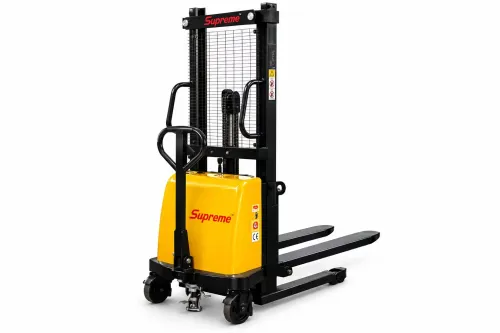
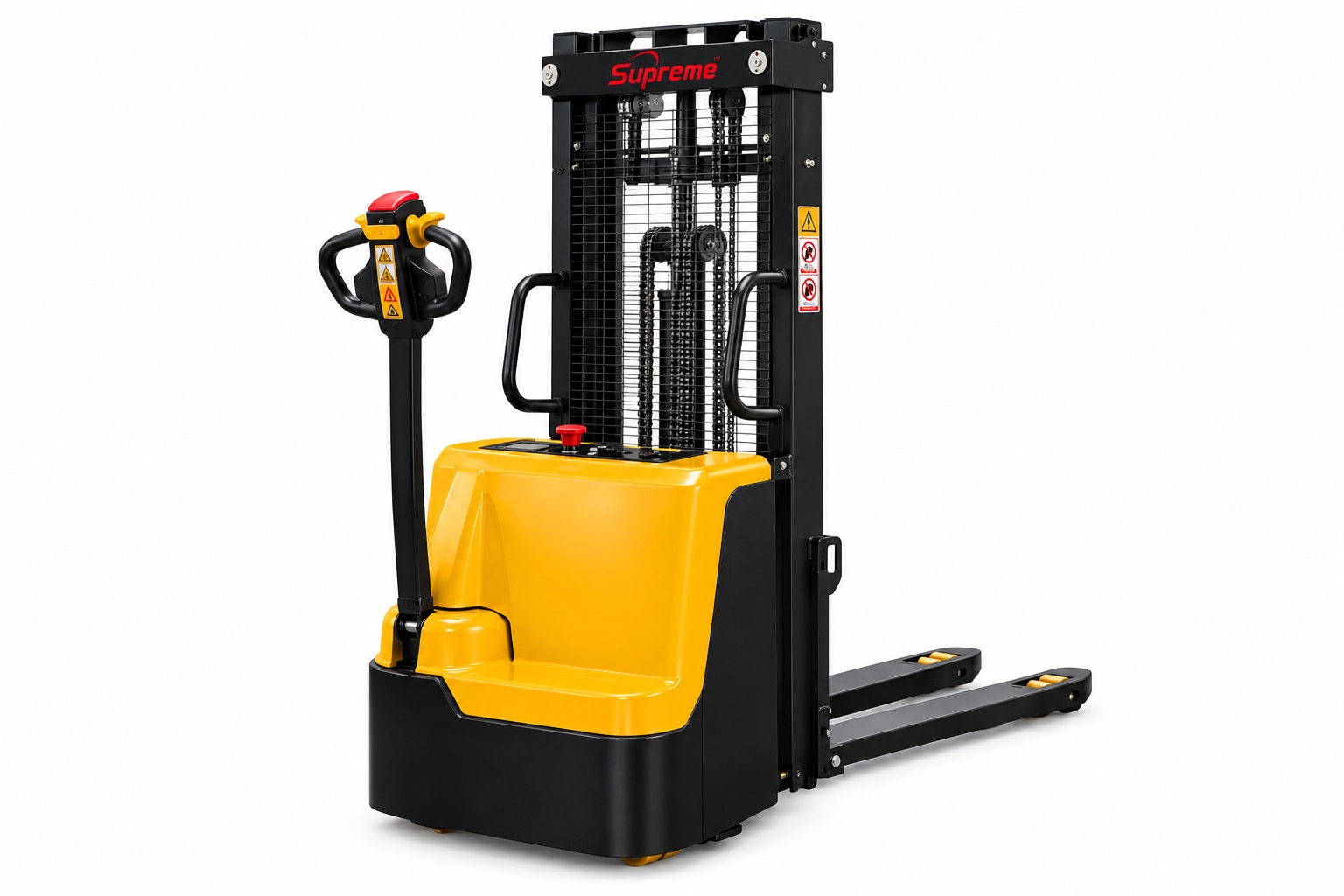 | Electric Stacker Supreme Fully Electric Stacker Supreme Fully Electric Stacker The Supreme Fully Electric Stacker is a high-performance material handling solution designed to make pallet lifting,... View product → |
Frequently asked questions
How do I confirm a fully electric stacker’s real capacity?
Ask for the rated-capacity chart showing permitted loads at your required lift height and load centre. Do not rely on the headline rating alone.
What should I measure before choosing an electric stacker in Jaipur?
Measure aisle width, turning clearance, doorway height, floor condition, rack height, pallet dimensions and the heaviest load you will handle.
How do I size the battery and charging point?
List operating hours, lifts per shift, travel distance, load weight and breaks between shifts. Confirm battery capacity, charger input, charging time, ventilation and socket requirements.
When is a powered or manual alternative better than a fully electric stacker?
Use a manual truck for short, light movements with few lifts. Choose a powered pallet truck for horizontal transport, and a stacker when you need controlled lifting and storage.
Keywords