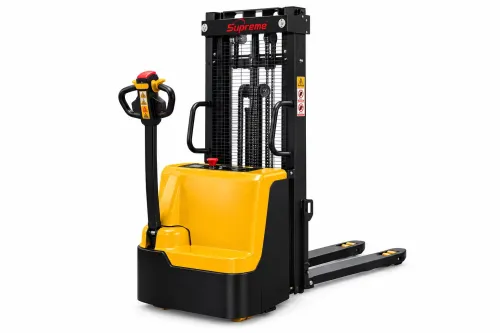
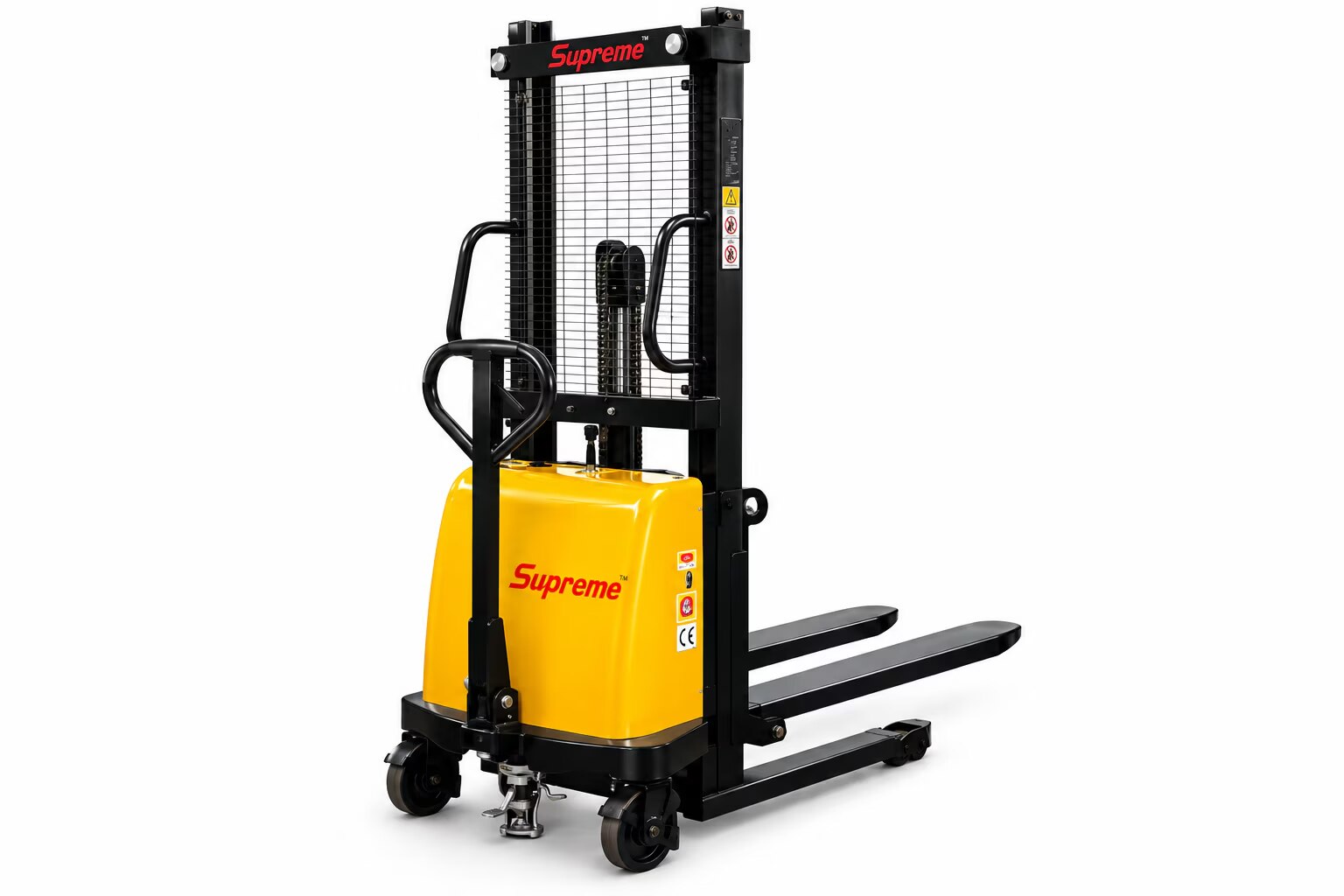
Park the stacker, lower the forks, remove the key and isolate the battery before inspecting any control or connector. A symptom-by-symptom check will help you separate a dead electrical supply, failed safety interlock, single-function fault, hydraulic fault and mechanical blockage before you replace parts or request service.
Key takeaways
- Lower the forks, remove the key and isolate the stacker before fault-finding.
- Check whether travel, lifting or every control has stopped working.
- Inspect battery charge, emergency-stop reset and control power connections.
- Stop testing if wiring, hydraulics or safety interlocks need specialist service.
Make the stacker safe before fault-finding
Park the stacker on level ground, lower the forks fully and remove the key before checking why semi electric stacker controls not responding in Jaipur. Keep people clear of the mast, never lift a person, and do not place hands near chains, rollers or forks. Never work beneath raised forks.
1. Press the emergency-stop button and wait for the machine to stop completely. Disconnect the battery using the manufacturer’s procedure before inspecting plugs, wiring, the main fuse or hydraulic components. Do not bypass the emergency-stop, dead-man or charger interlock to make the stacker move.
2. Photograph the controller display or LED fault code before cycling the key or battery. Repeated power cycling can hide an undervoltage, open-circuit, overtemperature or throttle-input fault.
3. Check that the battery connector is fully seated, the charge indicator is not showing a discharged battery, and no cable, plug or fuse is loose, crushed, burnt or corroded. Do not probe live circuits unless you are trained and have the service manual.
4. Record the model, serial number, battery voltage, fault code and whether the horn, display, lift, lower and travel functions work separately. Note whether the failure appears immediately or after warming up; this prevents an incompatible 12 V or 24 V replacement part and gives the technician a usable starting point.
Identify whether the failure is total or limited to one function
Treat a semi electric stacker control problem as a total failure only when every command is dead. Check the horn, display or indicator, travel, lifting and lowering separately; one working function proves that some control power remains.
Use the response pattern to narrow the fault:
- Horn, display, lift, lower and travel all fail: suspect the battery connector, key switch, emergency-stop circuit, main fuse or controller supply before blaming an individual motor.
- Horn and lift work, but forward and reverse do not: focus on the travel-enable circuit, tiller microswitch, direction switches, common supply and travel controller.
- Forward works but reverse does not, or reverse works but forward does not: inspect that direction’s switch, wiring and controller input. A failed traction motor usually does not remove only one direction.
- Travel works, but lifting and lowering both fail: investigate the lift command circuit, hydraulic control supply, pump contactor and lift controller rather than the travel system.
- Lifting works but lowering does not: check the lowering switch, valve-solenoid wiring and controller input; do not force the valve mechanically.
- Only the display or horn fails while movement works: treat that as a local control, fuse or wiring fault, not a complete shutdown.
A failed or misadjusted tiller microswitch can make the stacker controls not working symptom appear even when the battery, horn and lift remain available. Do not bypass that interlock. If a command fails, measure voltage at the controller input while applying it; battery voltage at rest can look normal while collapsing under load.
Check the battery, emergency-stop circuit and control supply
A lit battery indicator does not prove that the controller has usable voltage. Inspect the battery connector for heat marks, looseness or a backed-out pin, then check battery voltage and voltage while you command travel or lifting. A weak battery can show normal voltage at rest and collapse under load.
With battery isolation applied, inspect the main fuse, key-switch terminals and control wiring. Use the stacker’s wiring diagram and a meter to confirm continuity through the emergency-stop circuit. A released button can still have burned contacts, a loose terminal or a failed connector. Never bridge the emergency-stop circuit, even briefly.
| Symptom | Electrical checks | Likely direction |
|---|---|---|
| Dead panel, horn and lift | Battery plug, main fuse, key switch, emergency-stop contacts and controller supply | Open circuit, disconnected battery or missing control voltage |
| Panel on but no travel | Tiller microswitch, direction switches, travel-enable wiring and travel-controller supply | Travel interlock or controller-input fault |
| Lift command clicks but forks stay still | Battery voltage under load, lift fuse, contactor output and pump-motor supply | Hydraulic power circuit fault, not just a control fault |
For semi electric stacker troubleshooting in Jaipur, record the exact controller LED or display code before cycling the key or battery. Repeated resets can hide an undervoltage, overtemperature or open-circuit fault.
If the control supply is present but one function remains dead, stop replacing fuses and trace that function’s switches and connectors against the service manual.
Test interlocks and separate travel faults from hydraulic faults
Use the interlocks as a map: a semi electric stacker control problem that leaves the display, horn and lift available but blocks travel points toward the travel-enable circuit rather than the hydraulic pump.
- A tiller microswitch must change state when the handle enters its operating zone. A failed or misadjusted switch can leave the travel command open while lift still works.
- The dead-man control must be held in its permitted position. If releasing or squeezing it changes the symptom, inspect its switch, wiring and return movement.
- Remove the charger plug fully. The charger interlock prevents driving during charging; never bridge it to make the machine move.
- Check the brake interlock and drive wheel for release. A parking brake, jammed wheel or abnormal motor load can make the controller inhibit travel.
The symptom “stacker controls not working” points to a broader supply or safety fault when the display, horn, lift and travel all fail together. If travel and steering-related controls respond but the forks do not lift or lower, investigate the lift switch, pump motor, hydraulic oil level, valve wiring and mast obstruction instead.
A lift motor sound without fork movement suggests a hydraulic or mechanical problem; a silent motor with a valid command suggests its fuse, contactor, wiring or controller output. Never bypass a safety circuit to confirm a diagnosis.
Know when to stop testing and prepare a Jaipur service request
Stop testing immediately if the stacker moves without a command, the brake will not hold, forks lower by themselves, or a safety interlock has been bypassed.
Smoke, burning insulation, arcing, a hot battery plug, leaking hydraulic oil, a damaged chain, mast obstruction, or repeated controller overtemperature faults also require the key removed and the battery isolated.
| Warning sign | Required action | Why it matters |
|---|---|---|
| Uncontrolled travel or lifting | Keep clear, isolate the battery and tag the stacker out of service | A control or brake fault can cause crushing injuries |
| Smoke, arcing or hot wiring | Shut down without reconnecting the battery | Continued current flow can damage the controller or start a fire |
| Hydraulic leak, damaged chain or bent mast | Lower the load if safe, secure the area and stop use | Mechanical failure can cause sudden load or fork movement |
| Code returns after a reset | Record the exact code and stop repeated power cycling | The underlying undervoltage, open circuit or temperature fault remains |
For semi electric stacker troubleshooting in Jaipur, give the technician the model, serial number, battery nominal voltage, exact controller display or LED code, and the time the fault appears. State whether the horn, lift, lower, travel and display work separately, and whether the failure occurs when cold or after warming up.
Also report dust or corrosion near tiller switches and low connectors, recent charging, impact or repair work, and any jammed wheel or parking brake. Supreme Material Handling Equipment can use these details to identify the correct circuit and avoid fitting an incompatible 12 V or 24 V part.
This is the information needed when semi electric stacker controls not responding in Jaipur requires service rather than further checks.
Related product
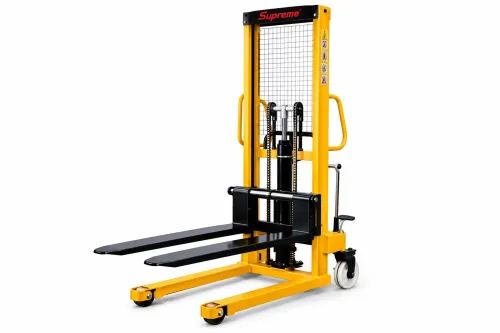
 | Electric Stacker Supreme Semi Electric Stacker is a reliable and cost-effective material handling solution designed for efficient pallet lifting and movement in... View product → |
Frequently asked questions
What should I do first when semi-electric stacker controls are not responding?
Park on level ground, lower the forks fully, remove the key and keep people away from the mast and forks. Never work beneath raised forks.
How can I tell whether the stacker control problem is total or limited?
Check each function separately: travel, lifting, lowering and horn. A total failure points toward battery, emergency-stop or control-supply faults; one failed function points toward its switch, wiring or interlock.
What should I check on the battery and emergency-stop circuit?
Confirm the battery is charged and connected, inspect the plug and visible cables, then release and reset the emergency-stop button. Stop if you find damaged wiring or signs of overheating.
How do I separate a travel fault from a hydraulic fault?
If the forks lift and lower but the stacker will not move, investigate travel controls, brake release and travel interlocks. If travel works but the forks do not lift, investigate the lift control, hydraulic system and related interlocks.
When should I request semi-electric stacker troubleshooting in Jaipur?
Request service when the fault remains after safe external checks, a fuse trips again, wiring is damaged, hydraulic oil leaks, an interlock fails or the stacker moves unexpectedly.
Keywords