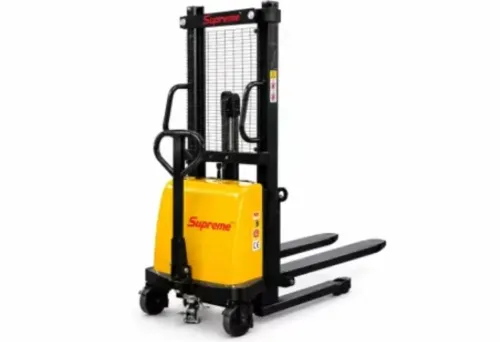

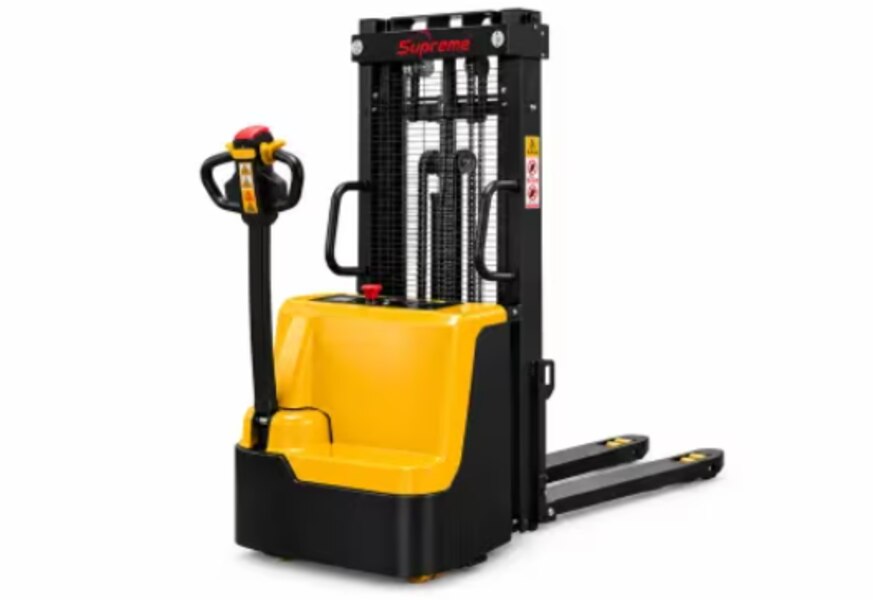
A fully electric stacker powers both travel and fork lifting, but the right machine still depends on capacity at your actual lift height, pallet dimensions, aisle width, floor condition, and battery duty cycle. By the end, you will have a practical checklist for comparing specifications, testing safety, and evaluating a Jaipur supplier’s quotation and service support.
Key takeaways
- Confirm travel, lifting, and lowering are all battery-powered.
- Match rated capacity and lift height to your heaviest, highest load.
- Ask for battery type, charger time, duty-cycle, and warranty details.
- Test turning, braking, mast visibility, and aisle clearance at your site.
What “Fully Electric” Means Before You Compare Suppliers
A genuinely fully electric stacker uses battery power for both traction and lifting. Travel, lifting, and lowering controls must be electric; the operator walks behind the machine or stands on its platform, steering with tiller-head controls instead of manually pushing, pumping, or positioning the load.
| Type | Operator position | Typical operating difference |
|---|---|---|
| Walkie stacker | Walks behind | Lowest protection and speed; compact turning radius for narrow aisles |
| Platform ride-on stacker | Stands on a platform | Faster travel and greater operator exposure; needs more aisle and stopping space |
| Counterbalanced electric forklift | Sits in a protected compartment | Larger turning radius, higher travel capability, and wider aisles; suits loads that cannot enter pallet racking directly |
Ask a fully electric stacker supplier in Jaipur to specify these safety and control features:
- Battery-powered travel, lift, and lowering controls; key switch; horn; reverse switch; emergency stop; service brake; parking brake
- Anti-roll-back on ramps; overload protection; mast guard; and tiller-head controls
An emergency stop does not replace a service brake or parking brake. Test controlled lowering, braking with and without a load, tiller-head emergency reversal, horn, key isolation, ramp anti-roll-back, and behaviour after electrical power loss.
A capacity figure such as 1,000 kg is incomplete without its load-centre dimension and residual-capacity chart. Confirm the mast type, maximum fork height, free-lift height, and rating at your actual lift height before accepting a quotation for a fully electric stacker in Jaipur.
How to Match Capacity, Lift Height, Forks, and Aisles
A 1,000 kg headline rating does not prove safe handling at your rack. Request a residual-capacity chart showing kilograms at each lift height, the rated load centre, mast configuration, and capacity at your actual fork height.
Capacity falls as the load centre moves forward because the load creates greater overturning force. A long, uneven, or damaged pallet shifts its centre of gravity and changes the stability calculation; do not accept the rating plate alone.
Compare these specifications:
- Maximum fork height, free-lift height, lowered fork height, and duplex or triplex mast type
- Fork length, fork width, adjustable fork range, and outside fork dimension
- Turning radius, gradeability, ground clearance, wheel type, and compatibility with your pallet sizes
- Overall length, overall width, lowered mast height, service weight, shipping footprint, and minimum aisle width
Choose lift height from the pallet top, rack-beam clearance, overhead doors, and lowest obstruction—not the top beam alone. Check pallet-board condition and allow clearance for mast movement.
| Model | Operator position and protection | Space requirement |
|---|---|---|
| Walkie stacker | Walking operator; compact protection and turning envelope | Narrow aisles if floor and clearance permit |
| Platform stacker | Standing operator; faster travel and added platform protection | Wider turning and stopping space |
| Counterbalanced forklift | Seated operator; counterweight and greater protection | Widest aisles and rack-end clearance |
Measure the narrowest aisle, rack-end clearance, doorway, dock plate, floor gradient, and stacking position before you buy electric stacker in Jaipur. A warehouse stacker supplier in Jaipur should provide these figures in writing, not infer them from a catalogue.
Battery, Charger, and Shift-Duty Questions That Change the Price
A battery’s amp-hour figure alone cannot predict a shift. Ask for operating hours or shifts per charge using stated travel distance, lifts per hour, average load, ramp use, regenerative braking, and battery age.
| Battery type | Operating trade-offs | Cost effect |
|---|---|---|
| Lead-acid | Lower purchase cost; requires ventilation, electrolyte watering, charging discipline, and cool-down time | Include watering labour, spare battery, and change equipment |
| Lithium-ion | Supports opportunity charging, avoids watering, and needs a battery-management system and compatible charger | Higher purchase cost; thermal protection and charger compatibility are essential |
Your quotation must name voltage, amp-hour capacity, charger type, input voltage, phase, output rating, plug and socket compatibility, charging clearance, ventilation, and the battery-removal method. Confirm whether a spare battery or battery-change system is included; a machine price without its charger is an incomplete comparison.
For hot, dusty, or monsoon-exposed Jaipur areas, ask for motor and controller protection, sealed connectors, the stated ingress-protection rating, wet-floor braking performance, and battery thermal safeguards. Indoor operation does not eliminate dust or water risk.
Check that the battery slides out without dismantling the mast, then price compatible batteries, chargers, controllers, contactors, traction wheels, chains, forks, and connectors. Get written stock and response terms, including labour and travel charges after warranty.
Search results for buy electric stacker in Jaipur and electric stacker manufacturer India are not comparable unless these duty and service details appear in the quotation.
Safety Tests, Site Conditions, and Operator Readiness
A stacker that works on a smooth floor can become unstable, hard to steer, or expensive to repair on broken concrete, potholes, expansion joints, ramps, wet floors, or uneven dock plates.
Ask a warehouse stacker supplier in Jaipur to state the wheel material, ground clearance, permitted floor gradient, minimum turning surface, and traction limits before arranging a trial.
1. Walk the planned route and measure its narrowest turning area, ramp, doorway, dock plate, and stacking position. Reject a model that strikes expansion joints, bottoms out on a dock plate, loses traction on wet flooring, or exceeds the stated gradient.
2. Demonstrate braking with no load and with the rated load. Test controlled lowering, lifting and travelling at rated load, tiller-head emergency reversal, horn, key isolation, emergency stop, parking brake, anti-roll-back on a ramp, and behaviour after electrical power loss. An emergency stop cuts power; it is not a service brake or parking brake.
3. Before each shift, inspect the forks, mast, chains, wheels, steering, brakes, horn, warning devices, guards, battery condition, leaks, and emergency controls. Remove the stacker from service when a crack, damaged fork, loose chain, fluid leak, failed brake, or ineffective warning device appears.
4. Require the operator manual, nameplate, battery and charger specifications, preventive-maintenance schedule, wiring and hydraulic schematics where applicable, warranty exclusions, commissioning record, and documented competent-operator training. Use OSHA’s powered-industrial-truck rule as a benchmark for inspection, training, charging, and modifications, then confirm Indian workplace requirements.
How to Evaluate a Jaipur Supplier Beyond the Machine Quote
A lower purchase price is not a saving if a failed controller stops dispatch for three days. Evaluate a fully electric stacker supplier in Jaipur on the cost of keeping the machine working, not just the figure at the bottom of the quote.
Ask every warehouse stacker supplier in Jaipur to state these items in writing:
- Rated capacity at your load centre and actual lift height, residual-capacity chart, mast type, maximum fork height, lowered mast height, and complete dimensions: length, width, turning radius, service weight, and minimum aisle width.
- Fork length, width, adjustable range, outside fork dimension, pallet compatibility, battery, charger, freight, delivery scope, commissioning, operator training, safety equipment, preventive-maintenance schedule, and warranty exclusions.
- Written service territory, maximum response time, post-warranty labour and travel charges, and stock arrangements for traction wheels, contactors, controllers, chargers, forks, chains, batteries, and connectors.
| Quote detail | Acceptable evidence | Cost risk if omitted |
|---|---|---|
| Rated capacity | Chart at your load centre and lift height | Unsafe overloading |
| Charger | Input, phase, output, plug, and battery-removal details | Unusable machine |
| Service | Response time, labour, travel, and parts stock | Extended downtime |
| Delivery | Freight, commissioning, training, and safety equipment | Unplanned site costs |
For a quotation from Supreme Material Handling Equipment, submit pallet weight and dimensions, rack height, aisle and doorway measurements, floor conditions, daily lifts, travel distance, shifts, charging access, and site photographs. Request a written residual-capacity and service proposal.
Compare two or more quotations line by line. Reject any proposal missing the charger, load-centre rating, lowered mast height, safety equipment, or after-sales response terms, including one from an electric stacker manufacturer India.
Related product
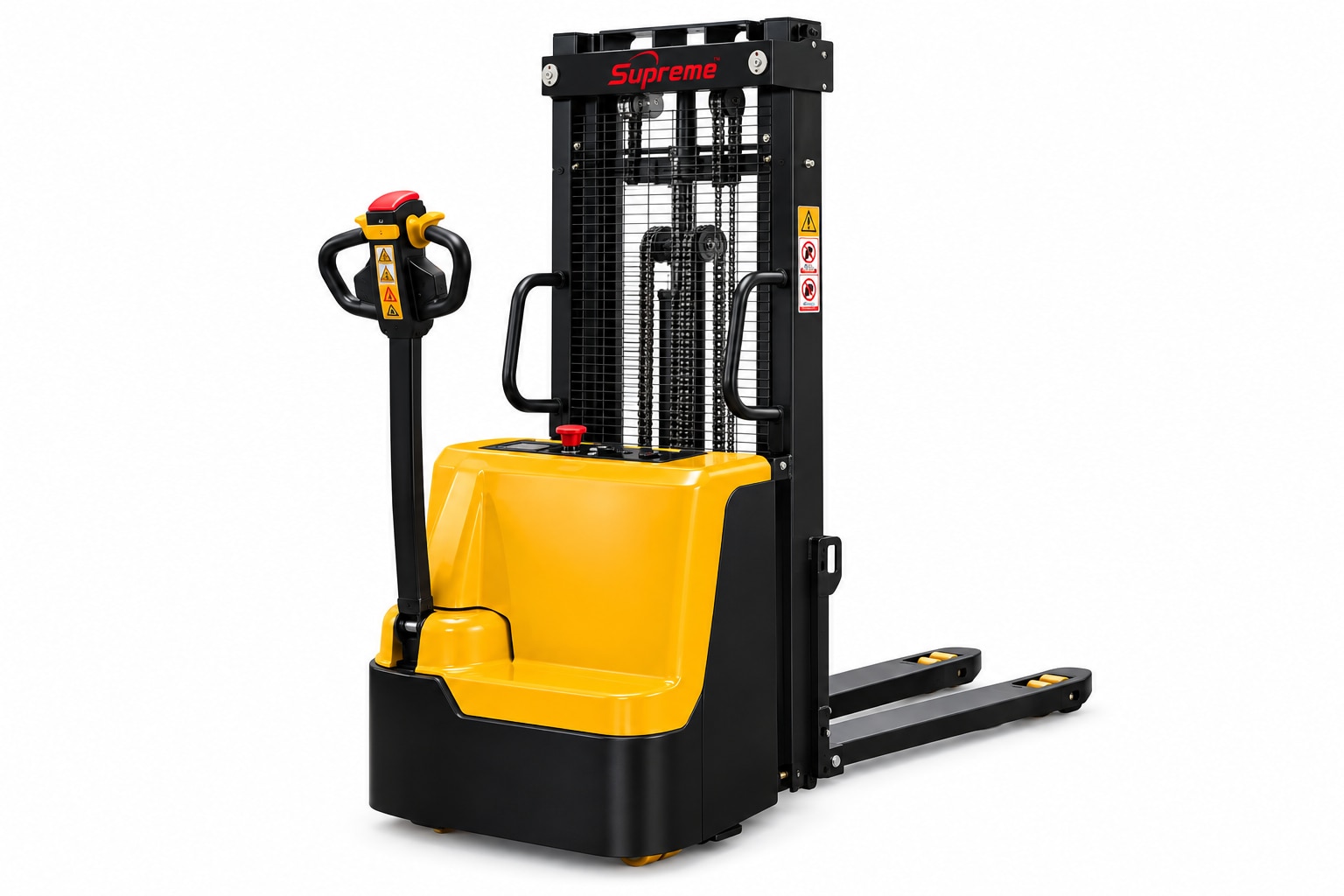 | Electric Stacker Supreme Fully Electric Stacker Supreme Fully Electric Stacker The Supreme Fully Electric Stacker is a high-performance material handling solution designed to make pallet lifting,... View product → |
Frequently asked questions
What does fully electric mean in a warehouse stacker?
A fully electric stacker uses battery power for travel, lifting, and lowering. The operator does not manually push, pump, or position the load.
How do you choose the right electric stacker capacity and lift height?
Use the heaviest load as the starting point, then confirm the required lift height, fork dimensions, load centre, and narrowest aisle at your site.
Which battery and charger questions affect an electric stacker quote?
Ask about battery chemistry and capacity, charging duration, charging location, shift duty, spare batteries, charger compatibility, and warranty coverage.
What should you test before buying a fully electric stacker?
Test braking, steering, emergency stop operation, horn, lowering control, mast visibility, turning clearance, floor condition, and operation with a representative pallet.
How can you evaluate a warehouse stacker supplier in Jaipur?
Compare commissioning, operator training, preventive maintenance, spare-parts availability, response times, warranty exclusions, and written delivery specifications—not only the machine price.