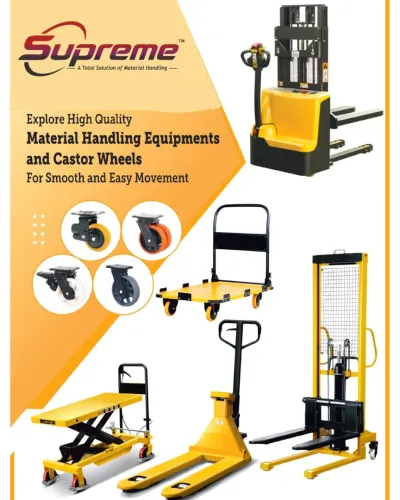

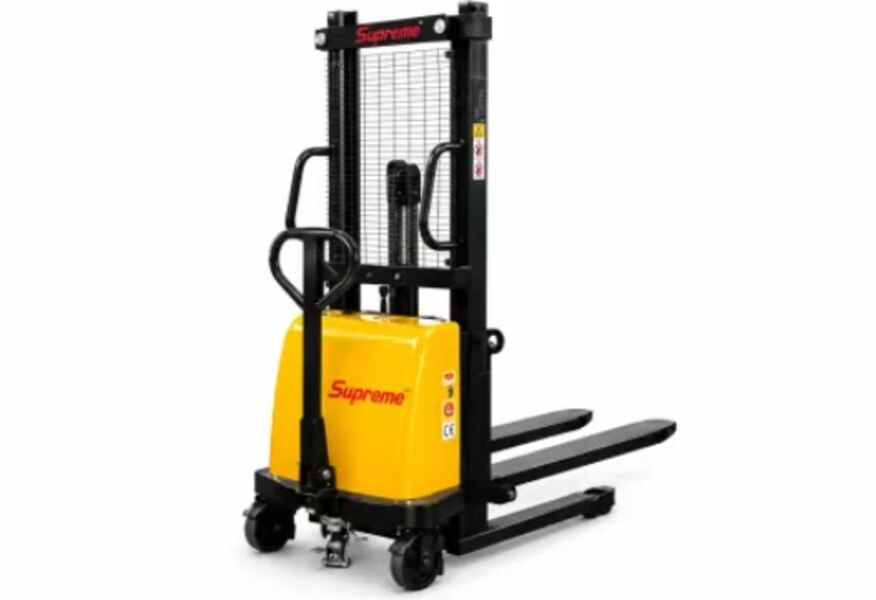
A semi-electric stacker can remove repeated pumping and make pallet placement more controlled, but a walk-behind model still demands manual travel and steering. By checking your load chart, route, floor, rack geometry, shift volume, battery arrangements, and service support, you can decide whether the lower complexity outweighs that effort.
Key takeaways
- Confirm whether lifting, lowering, and travel are motorised.
- Choose it for short travel distances and moderate pallet movement.
- Check floor flatness, rack clearances, load ratings, and battery access.
- Demand written specifications, warranty terms, training, and service coverage.
What does a semi-electric stacker actually power?
Confirm the motor functions before comparing prices. In the common walk-behind design, an electric motor raises the forks, but the operator pushes, pulls, and steers the machine. Lowering may use a hydraulic release valve or a powered control, so the product name alone does not tell you what is motorised.
| Function | Common configuration | What to confirm |
|---|---|---|
| Fork lifting | Electric motor | Lift speed, control type, and rated load |
| Travel | Manual push or pull | Whether powered drive is included |
| Steering | Manual tiller movement | Whether steering assistance is fitted |
| Lowering | Hydraulic release valve | Whether lowering is powered |
| Braking | Mechanical brake | Whether electromagnetic braking is included |
Some semi-electric models add powered travel, steering assistance, or electromagnetic braking. A buyer searching for a semi electric stacker for warehouse in Jaipur should ask for each function on the quotation, not accept “semi-electric” as a complete specification.
Powered lifting removes repeated pump strokes and gives steadier fork positioning during pallet placement. Those semi electric stacker benefits reduce lifting effort, but manual travel still adds pushing force, travel time, and fatigue; this is not a fully electric truck.
A short demonstration with your loaded pallet reveals more than an unloaded showroom test: check starting effort, turning, stopping, lowering control, and placement accuracy.
Does your Jaipur warehouse suit a semi-electric stacker?
It suits your warehouse when electric lifting removes repetitive pumping, while manual travel remains manageable for the route, floor, and daily workload. Test the actual operation before choosing a semi electric stacker for warehouse in Jaipur.
Record these site figures:
- Pallet weight, load-centre distance, intended lift height, and rack beam height.
- Daily pallet movements, lift cycles per hour, and travel distance per cycle.
- Aisle width, turning space, floor joints, gradients, and dock thresholds.
- Available charging points, charging location, and battery access during shifts.
Check capacity at the intended lift height and load centre using the capacity plate or residual-capacity chart. A headline rating such as 1,000 kg does not prove that the machine can lift 1,000 kg at your rack height or load geometry.
Manual travel is acceptable for short to moderate routes, repetitive lifting, sound floors, and manageable throughput. It becomes the wrong choice for:
- Long dock-to-rack routes or high daily cycle counts.
- Steep ramps, rough concrete, or frequent outdoor use.
- Very high lifts or loads above the rated chart.
A warehouse stacker machine in Jaipur must also suit local heat. Require the supplier to state the battery and charger’s permitted ambient operating and charging range; excessive heat can reduce battery life or stop charging. If pushing force, travel time, or fatigue is already high, compare a powered-travel stacker instead.
How does it compare with other pallet-handling equipment?
A semi-electric stacker is worth the premium over manual equipment when lifting is repetitive but travel is short to moderate. It reduces pump strokes, steadies fork positioning and lowers lifting effort, while the operator still pushes and steers in the common configuration.
| Option | Lift height and travel | Operator effort and speed | Charging, maintenance and cost |
|---|---|---|---|
| Semi-electric stacker | Rack stacking; manual horizontal travel | Less lifting effort, but pushing limits speed | Battery and charger required; moderate purchase and service cost |
| Manual stacker | Rack stacking; manual travel | Pumping and pushing; slow on repeated cycles | No charging; simpler maintenance and lower purchase cost |
| Fully electric stacker | Rack stacking; powered travel | Lower steering effort and faster movement | Higher cost; adds drive, controller, battery and charger maintenance |
| Electric pallet truck | Floor-level movement; no practical rack stacking | Fast horizontal travel with low travel effort | Charging and drive-system maintenance; poor substitute for stacking |
| Hand pallet truck | Short, floor-level movement only | Lowest complexity; manual pumping and pulling | No charging; lowest purchase and maintenance cost |
For a warehouse stacker machine in Jaipur, record pallets per shift, metres per trip, lift cycles per hour, load weight, charging downtime, labour hours, battery replacement interval and service cost. Compare the observed cycle with the alternative, not an unsupported payback claim.
Long dock-to-rack routes, ramps or high daily volumes can make pushing force, travel time and fatigue outweigh the semi electric stacker benefits. A fully electric stacker then earns consideration; an electric pallet truck fits fast horizontal movement when stacking is unnecessary.
How do you verify floor, rack, and operating safety before purchase?
Verify every claimed capacity through a loaded site trial, not a brochure’s capacity, lift height, or advertised aisle width. For a semi electric stacker for warehouse in jaipur, use the actual pallets and rack positions.
1. Measure aisle clearance with the loaded pallet, rack-entry clearance below the beam, fork-entry depth, mast overhead clearance, turning radius, dock thresholds, floor joints, drainage channels, loose debris, and the worst gradient.
2. Run the machine with the heaviest pallet and the most common pallet type. Reject it if it becomes unstable, hard to push, obstructs visibility, or cannot enter the rack without contact. Obtain permissible-gradient data for the exact model and approve no ramp that the manufacturer has not authorised.
3. During the trial, inspect pallet boards, centre the load, keep the mast and load visible, and travel with forks lowered. Mark pedestrian routes, install barriers, and prevent access to unauthorised ramps. Park with forks lowered and the brake applied, then demonstrate the emergency-lowering control.
Charge only in the designated battery area. Lead-acid batteries require ventilation, spill-response materials, ignition-source control, and emergency washing facilities. Lithium-ion batteries require the matched charger and battery-management system; never substitute either component. A warehouse stacker machine in jaipur is suitable only when the complete configuration passes this loaded, supervised test.
What must a semi electric stacker supplier in Jaipur put in writing?
A quotation is useful only when it describes the exact configuration you will operate. Ask Supreme Material Handling Equipment, or any semi electric stacker supplier in Jaipur, to put these points in writing:
1. Rated load at every intended lift height and load centre; maximum lift height; lowered fork height; fork dimensions; overall width; turning radius; mast type; ground clearance; wheel material; brake type; battery voltage; ampere-hour capacity; charging time; duty cycle; ambient temperature limits; and emergency-lowering details.
2. Warranty terms for the machine, battery, and charger separately. Also request battery and charger replacement prices, preventive-maintenance intervals, service response time, and spare-parts availability for forks, wheels, controllers, contactors, and chargers. Include operator training and the inspection-record format.
3. For a warehouse stacker machine in Jaipur, require a written loaded trial using your heaviest and most common pallets. Record charging access, battery replacement arrangements, rack compatibility, and the manual travel effort across the longest route, including any threshold or gradient.
Do not accept a headline capacity such as 1,000 kg without the residual-capacity chart for the quoted mast, lift height, and load centre. If the supplier cannot provide that chart or identify the exact configuration, postpone the purchase; a low price is poor value if a proprietary controller leaves the machine idle for weeks.
Related product
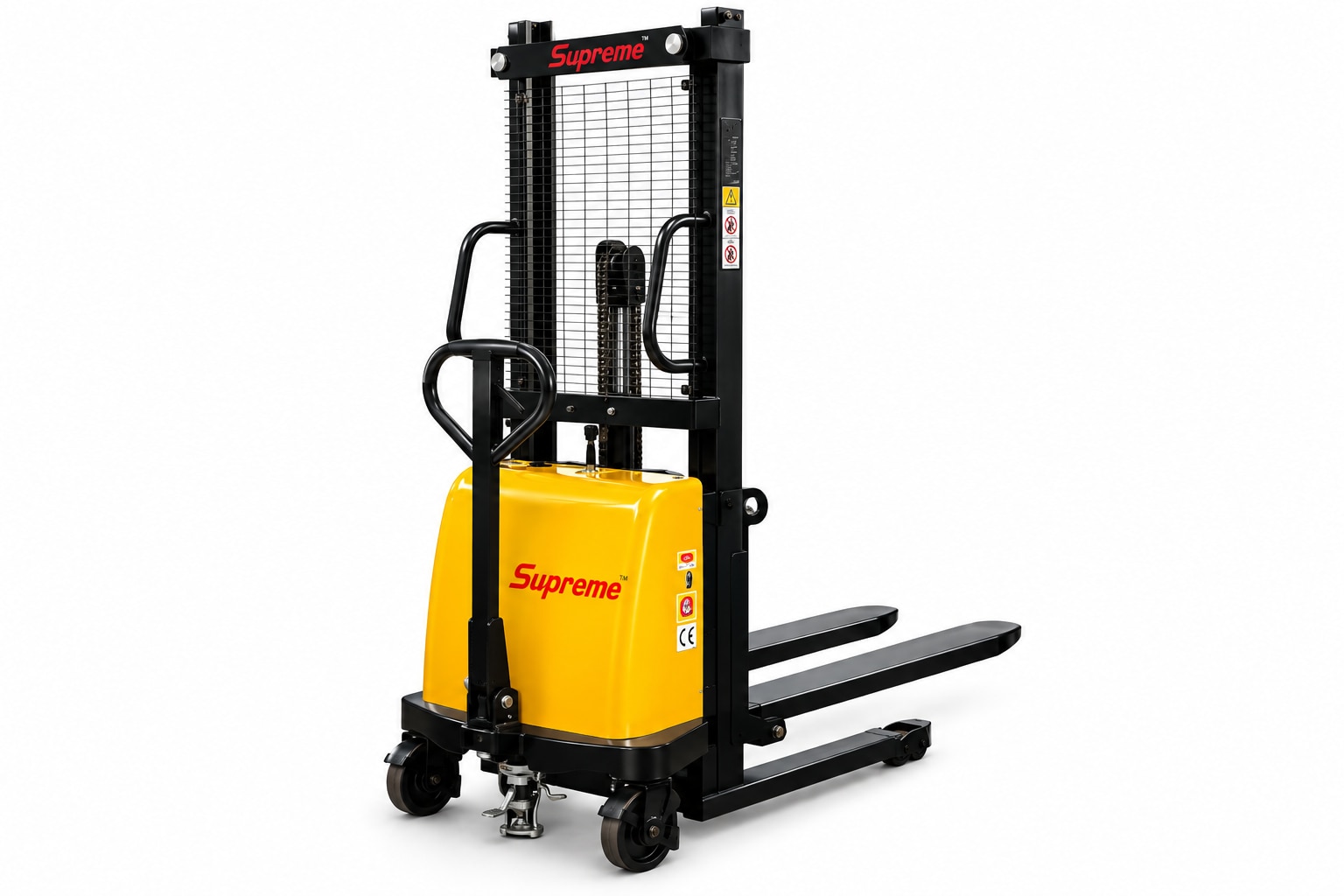 | Electric Stacker Supreme Semi Electric Stacker is a reliable and cost-effective material handling solution designed for efficient pallet lifting and movement in... View product → |
Frequently asked questions
What does a semi-electric stacker actually power?
In the common walk-behind design, an electric motor raises the forks while the operator pushes, pulls, and steers. Lowering can use a hydraulic release valve or a powered control, so verify each function before comparing models.
Does a Jaipur warehouse suit a semi-electric stacker?
It suits a warehouse with level, sound floors, short travel routes, suitable aisle width, compatible rack clearances, and loads within the machine’s rated capacity. Choose another machine when frequent long-distance travel or high-volume movement makes manual pushing inefficient.
How does a semi-electric stacker compare with other pallet-handling equipment?
A semi-electric stacker reduces lifting effort at a lower complexity than a fully electric stacker, but it still requires manual travel. Compare it with pallet trucks, fully electric stackers, and forklifts based on lift height, travel distance, pallet weight, aisle space, and daily operating hours.
What must a semi-electric stacker supplier in Jaipur put in writing?
Request the rated load, load-centre distance, lift height, fork dimensions, battery and charger details, machine weight, turning radius, warranty coverage, spare-parts availability, service response terms, operator training, and delivery scope.